Share:


Table of Content
By Alex Silensky, Partner, OGScapital · Updated November 2026
If your biggest shipper ended its contract the month after you closed, would the business still make money? For most courier companies that is the question that sets the price, more than last year’s EBITDA.
Due diligence on a courier or delivery business comes down to three things: who pays, who drives, and what the vans really cost. Try the numbers for the business you are looking at first.
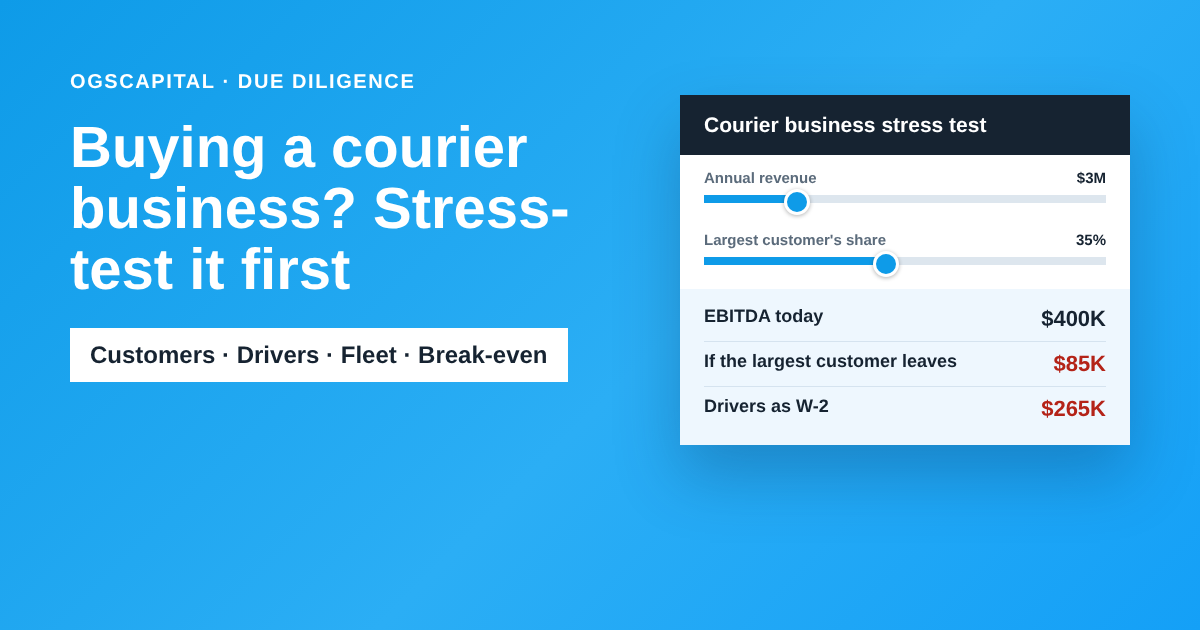
Courier business stress test
Move the sliders to match the target. Nothing you enter leaves this page.
Payroll taxes and workers’ comp as a share of pay. Your number depends on the state and insurer; 15% is only a starting point.
The three questions that set the price
Who pays, and can they leave?
Delivery companies often grow around one retailer, platform or freight partner. Revenue from that customer is only as good as the contract behind it: the term, the notice period, and whether the customer can cut volume or rates without ending the deal.
A QoE shows revenue by customer by month for two to three years, so you can see whether a large account is growing, flat or already shrinking. It also checks whether rates or fuel surcharges changed during the year, because a trailing twelve months can include a rate the customer has since cut.
Ask the seller for: revenue by customer by month, every customer contract, current rate sheets and fuel surcharge schedules.
Who drives, and on what terms?
Many courier companies pay drivers as 1099 contractors. When those drivers work full time, on routes the company sets, in company vans, under company dispatch, a state agency or the IRS may treat them as employees. The cost difference is real money: employer payroll taxes, workers' comp, overtime.
A QoE prices that difference into EBITDA so you see what the business earns if the model has to change. Whether the drivers are misclassified under your state's rules is a question for your attorney, and exposure for past years is usually handled in the purchase agreement with an indemnity or escrow.
Ask the seller for: a driver list with pay type, hours and routes, contractor agreements, payroll and 1099 payments by month.
What do the vans really cost?
Insurance and the fleet are where seller numbers most often run light. Commercial auto liability can rise sharply at renewal or after claims, so the renewal quote matters more than this year's premium. Leases that end soon after closing, vans near the end of their life, and engine or transmission repairs booked as assets instead of expenses all make earnings look higher than they are.
Before accepting a repair as a one-time add-back, a QoE checks the repair history van by van. On an aging fleet, big repairs are usually part of running the business.
Ask the seller for: fleet list with year, mileage and lease end dates, repair invoices, insurance policies, renewal quotes and five-year loss runs.
Same company, two answers
A regional courier with about $3.0 million in revenue, 22 vans and two large shippers. The LOI priced it at 3.5x the seller's EBITDA.
Seller's adjusted EBITDA
$520,000
- Drivers on 1099 at contractor cost
- This year's insurance premium
- Engine and transmission repairs capitalized
- Owner's driving on peak days not costed
After a QoE
$400,000
- Drivers priced as W-2: −$45,000
- Renewal quote, not current premium: −$35,000
- Repairs expensed: −$25,000
- Relief driver for the owner: −$15,000
At the same 3.5x, the gap is $420,000 of price: $1,400,000 instead of $1,820,000. The defaults in the stress test above are this company. Its largest shipper is 35% of revenue, and losing it would take EBITDA from $400,000 to about $85,000.
Hypothetical figures. They do not describe any OGScapital client. Across the roughly 100 QoE reports OGScapital prepares a year, verified EBITDA comes in about 20% below the seller's number on average.
The cash gap every courier business carries
Drivers and fuel are paid every week. Large shippers often pay on 30 to 60 day terms. Between the two sits a cash gap that the business has to fund all the time.
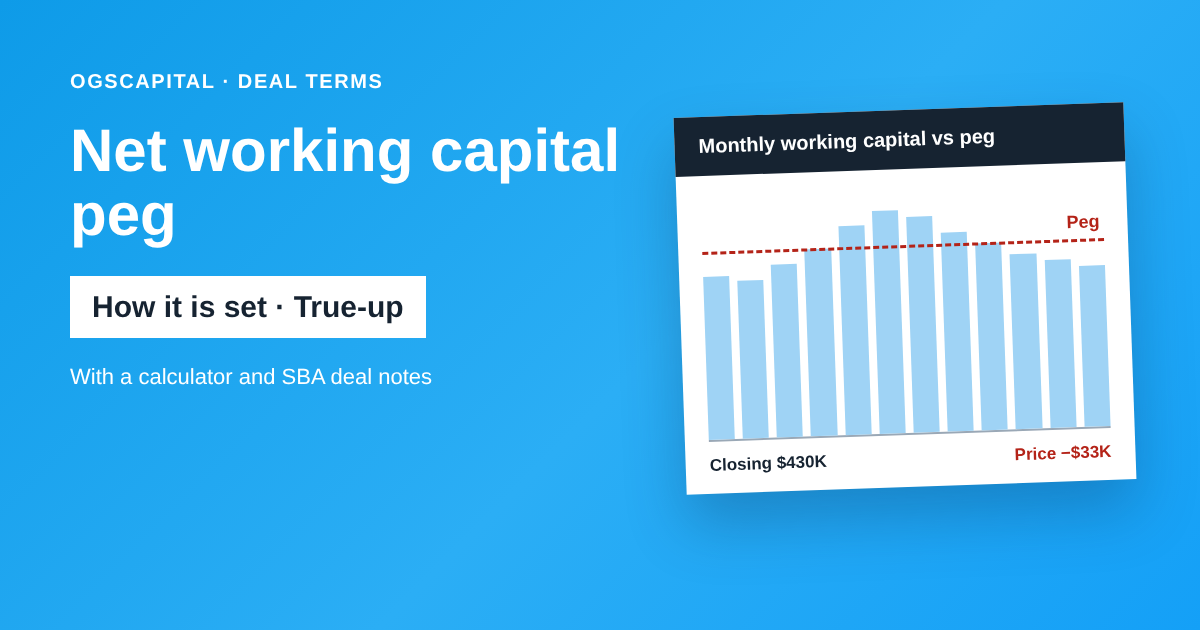
In the example company, about $175,000 a month goes to drivers, fuel and vehicles. With customers paying in about 45 days, roughly $260,000 of costs are paid out before the first invoice comes in. That money has to stay in the business at closing. A QoE sets the working capital peg from monthly receivables and payables so the buyer does not fund the gap from their own pocket. More: how the working capital peg is set.
From a real deal
Parcel and courier services, San Antonio, Texas
"We're impressed with their good communication."
Tukari was deciding whether to buy a business and hired OGScapital to validate its financials, confirm its margins and run a break-even analysis: the same three tests as the stress test above. The buyer got a confirmed view of the business's financial health and risks before deciding, and the work was delivered earlier than expected.
Client review on OGScapital's Clutch profile. Deal figures are confidential.
Looking at a courier or delivery business?
Send us the deal and we will run the stress test on the target's real numbers as part of a fixed-price QoE: about two weeks, from $5,500.
Prefer to talk? +1-619-727-5304
Questions buyers ask
What due diligence do I need to buy a courier business?
Revenue by customer with the contracts behind it, driver pay and classification, fleet and insurance costs, and a break-even test. A quality of earnings report puts it all on an accrual basis and shows what the business really earns.
What is the biggest risk when buying a delivery company?
Usually customer concentration. If one shipper brings a third or more of revenue and can end the contract on short notice, losing it can wipe out most of the profit.
What is the real cost if drivers are reclassified from 1099 to W-2?
Employer payroll taxes, workers' comp, overtime and often benefits, plus possible back taxes and penalties for past years. A QoE prices the ongoing cost into EBITDA; past exposure is a legal question usually handled with an indemnity or escrow in the purchase agreement.
How much working capital should stay in a courier business at closing?
Enough to cover the gap between paying drivers and fuel every week and collecting from shippers on 30 to 60 day terms. A QoE sets the working capital peg from monthly receivables and payables.
How do you separate fleet repairs from capital expenses?
Routine maintenance, tires and brakes are operating costs. On an aging fleet, engine and transmission replacements recur too, so a QoE checks repair history by vehicle before accepting a repair as a one-time add-back.
Can I use an SBA loan to buy a courier business?
Courier and delivery businesses can generally be financed with SBA 7(a) loans. The lender checks that verified cash flow covers debt service, usually at 1.25x or more, and needs a third-party QoE once the price is $3 million or more.
How much does due diligence on a courier business cost?
At OGScapital, a focused buy-side QoE starts at $5,500 and takes about two weeks once documents are in. A full-scope QoE starts at $10,000.