Share:


Table of Content
By Alex Silensky, Partner, and the OGScapital transaction advisory team (CPA, CVA) · Updated November 2026
SHORT ANSWER: WHAT IS A WORKING CAPITAL PEG?
The normal level of working capital the seller must leave in the business.
The net working capital peg is the amount of receivables and inventory, minus payables and accruals, that the business normally needs to run. It is written into the purchase agreement, usually as the average of the last twelve months, adjusted for seasonality and one-off items. At closing, actual working capital is compared with the peg. If the seller delivers less, the price goes down by the shortfall. If they deliver more, the seller is paid the difference. Cash and debt are usually left out.
What goes into net working capital
Working capital is the money tied up in running the business day to day. A buyer pays a price for the business on the assumption that this “fuel” comes with it. The definition matters as much as the number, so attach it to the purchase agreement as a schedule, account by account.
Usually included
- Accounts receivable, net of a realistic bad-debt reserve
- Inventory, net of obsolete or slow-moving stock
- Prepaid expenses
- Minus accounts payable
- Minus accrued payroll, bonuses, PTO and other accruals
- Minus customer deposits and deferred revenue
Usually excluded
- Cash: the seller keeps it
- Bank debt and the current part of loans: the seller pays it off
- Income taxes
- Loans to or from the owner
- Transaction costs: broker, legal and QoE fees
Example: setting the peg for a seasonal distributor
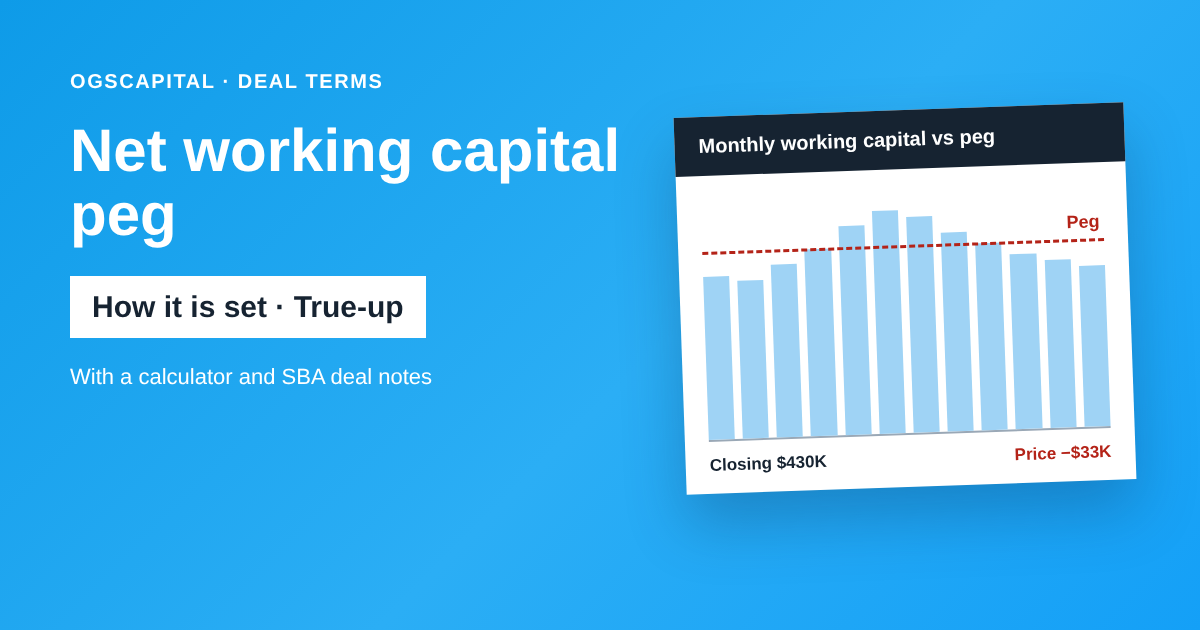
An illustrative distributor with about $6 million in revenue. Monthly net working capital over the last twelve months ranged from $395,000 to $560,000. The average, $463,333, rounds to a peg of $463,000.
Net working capital at each month end, in thousands. Illustrative figures.
Now look at when the deal closes. In December, working capital is naturally about $405,000, so a $463,000 peg would cost the seller $58,000 for a normal seasonal dip. In June it is about $560,000, and the buyer would owe the seller $97,000 for the same reason. That is why seasonal businesses often use a peg for the closing month, or the same month last year, instead of a flat annual average.
The true-up. Say the deal closes with an estimated $430,000. The price is cut by $33,000 at closing. Ninety days later the final closing balance sheet shows $418,000, so the seller owes another $12,000.
Working capital true-up calculator
Enter the peg from your LOI and the closing balances. All amounts in dollars.
The seller delivered less than the peg, so the price goes down by $33,000.
See a working capital analysis in a real QoE
We will email you a redacted OGScapital quality of earnings report, including the monthly working capital analysis and the proposed peg.
How the peg is set
Both sides calculate a peg and negotiate. The method matters more than people expect: on the example above, the choice between a flat average and a closing-month target moves the price by up to $97,000.
| Method | Best for | Why |
|---|---|---|
| Twelve-month average | Most businesses | Smooths monthly swings. The default starting point. |
| Closing-month target or same month last year | Seasonal businesses | Avoids charging either side for a normal seasonal swing. |
| Three- to six-month average | Fast-growing businesses | A twelve-month average understates what a bigger business now needs. |
| Normalized average | Any business with one-offs | Removes a large one-time order, a stock build before a price increase, a late customer payment. |
FROM OUR QOE WORK · SEASONAL MANUFACTURER
A twelve-month peg would have left the buyer $600K short
- The dispute
- The seller argued for a peg based on the twelve-month average. Our QoE showed that working capital needs had jumped with recent growth. On the twelve-month average, the seller could have taken cash out before closing and left the buyer with a $600,000 working capital gap to fund the next inventory build.
- How it was resolved
- We modeled a trailing three-month peg normalized for seasonality and took obsolete inventory out of the calculation. Both sides agreed to it, and the buyer got enough working capital at closing to run the business without putting in extra cash on day one.
Small business deals and SBA loans
Many Main Street deals leave working capital out. Smaller businesses are often sold as an asset sale on a cash-free, debt-free basis: the seller keeps the cash, collects the receivables and pays the payables, and the price covers equipment, a normal level of inventory and goodwill. Then there is no peg, but you start with no receivables, so the working capital you need has to be funded, often by adding it to the SBA loan or a separate credit line.
If working capital is included, the price cannot go up. An SBA lender underwrites a fixed price, so a standard clause that raises the price when the seller delivers more does not fit. Buyers and lawyers usually handle it this way: a shortfall reduces the seller note dollar for dollar, and any excess is paid to the seller only as the extra receivables are collected.
Get the lender to approve the language early. True-up clauses agreed in good faith at the LOI stage are sometimes struck by the lender’s counsel just before closing. Send the draft to the lender as soon as it exists.
Where working capital disputes come from
Set the peg on numbers you can defend
A full-scope OGScapital QoE includes a monthly net working capital analysis for the trailing period, adjustments for one-offs and seasonality, and a proposed peg you can put into the LOI. If the QoE also finds lower earnings, see what to do when the QoE finds lower EBITDA.
Full-scope QoE with working capital and a proposed peg, in 3–4 weeks.
GET A QUOTENegotiating a peg right now?
Tell us about the deal. We will send a QoE scope with a working capital analysis, one fixed price and a delivery date.
Prefer to talk? +1-619-727-5304
FAQ
What is a net working capital peg?
The agreed normal level of net working capital (receivables, inventory and prepaids minus payables and accruals) that the seller must deliver at closing. If actual working capital is lower, the price goes down; if higher, the seller is paid the difference.
How is the working capital peg calculated?
Usually as the average of month-end net working capital over the last twelve months, adjusted for one-off items. Seasonal businesses often use a closing-month target, and fast-growing ones a three- to six-month average.
Is cash included in working capital?
Usually not. Most deals are cash-free and debt-free: the seller keeps the cash and pays off the debt, and the peg covers operating items only.
What is a working capital true-up?
The price adjustment for the difference between closing working capital and the peg. An estimate is used at closing, then the final figure is settled from the closing balance sheet, often 60 to 120 days later.
Do small business deals have a working capital peg?
Many do not. Smaller asset deals are often cash-free and debt-free with receivables and payables left with the seller, so the buyer funds working capital separately, often through the SBA loan or a credit line.
How does a working capital adjustment work with an SBA loan?
The price cannot go up after the lender underwrites it, so a shortfall usually reduces the seller note and any excess is paid to the seller as the extra receivables are collected. Agree the wording with the lender early.
Who sets the working capital peg?
Buyer and seller negotiate it, each based on their own analysis. A quality of earnings report usually includes the monthly working capital analysis and a proposed peg.
What can the seller do to lower working capital before closing?
Collect receivables early, stop buying inventory or delay paying vendors. A clear definition, a peg based on normal operations and a true-up on the final balance sheet protect the buyer.