Share:


Table of Content
By Alex Silensky, Partner, and the OGScapital transaction advisory team (CPA, CVA) · Updated November 2026
SHORT ANSWER: WHAT A QOE CHECKS IN AN HVAC COMPANY
Recurring revenue, the season, customer deposits and who holds the license.
An HVAC company is usually priced on its maintenance agreements and on how steady its service work is. A quality of earnings report tests both. It separates agreement revenue from one-time installs, moves prepaid agreements and install deposits out of revenue until the work is done, prices in a manager or license holder to replace the owner, and sets a working capital peg that fits a business that peaks every summer. Those few lines are where seller EBITDA and verified EBITDA usually part ways.
Six places where HVAC numbers mislead
Most small HVAC companies keep books on a cash basis and run jobs in a field service app. That is fine for running the business. For pricing it, the numbers need to be put on an accrual basis and tied to the jobs behind them. These are the lines we test first.
Maintenance agreements
How many, at what price, how many renewed last year, and whether they are billed upfront. Agreements billed for a year ahead are earned month by month, not on the day the customer pays.
Install vs service mix
Replacement installs are big, lumpy and weather-driven. Service and agreement work repeats. Gross margin by job type shows which part of EBITDA a buyer can count on.
Customer deposits and jobs in progress
A deposit for a system not yet installed is money the business still owes in work. Booked as revenue, it inflates earnings and the cash the seller leaves behind.
Technicians and their pay
Summer overtime, spiffs on equipment sales and on-call pay often sit outside payroll reports. Losing one or two senior techs after closing can cut capacity more than any customer loss.
The owner’s role and license
Many owners are the lead tech, the estimator and the license holder. Their add-back only holds if the buyer budgets for the people who replace them, and a contractor license generally does not transfer with the business.
Warranty work, rebates and the fleet
Labor warranty callbacks, manufacturer and distributor rebates paid once a year, and vans past their useful life all move true annual earnings.
Example: an HVAC company with $780K of seller EBITDA
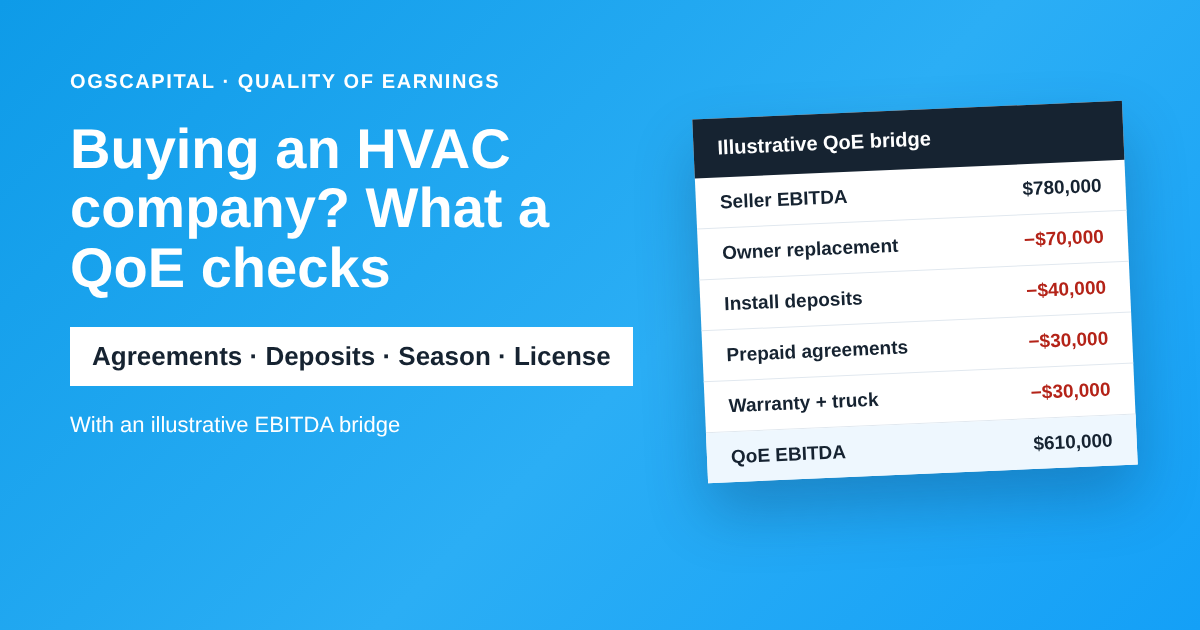
A residential and light commercial HVAC company with about $4.2 million in revenue, four trucks and a third of its revenue from maintenance agreements. The LOI priced it at 4.0x the seller’s adjusted EBITDA of $780,000, or $3,120,000. This is how a QoE bridge for a business like this often looks.
| Line | Amount | Type |
|---|---|---|
| Seller’s adjusted EBITDAAs presented in the broker package | $780,000 | |
| Owner replacementThe owner is lead tech and license holder. A service manager who can qualify the license costs more than the salary already in the books. | −$70,000 | Judgment |
| Install depositsDeposits for installs scheduled after year end were booked as revenue. | −$40,000 | Timing |
| Prepaid agreementsA new annual plan sold in the spring was billed upfront and booked in full. | −$30,000 | Timing |
| Labor warrantyCallback labor on last season’s installs was not accrued. | −$15,000 | Hard |
| Pickup truck add-backThe truck is used for estimates every day. The add-back was rejected. | −$15,000 | Hard |
| QoE EBITDAVerified, on an accrual basis | $610,000 |
Hypothetical figures, built from patterns that are common in HVAC deals. They do not describe any OGScapital client.
$170,000 less EBITDA at the same 4.0x is $680,000 less value: $2,440,000 instead of $3,120,000. Not all of it is equal. The truck and the warranty cost are hard findings. The two timing items are real for the trailing twelve months, and also mean the business owes work and cash at closing. The owner replacement depends on what the role really costs in that market, which is where buyers and sellers usually negotiate. For how to take a lower number back to the seller, see what to do when the QoE finds lower EBITDA.
Financing. At a purchase price of $3 million or more, an SBA lender now needs a QoE of its own, and for most change of ownership loans approved on or after October 1, 2026 it looks for at least 1.25x debt service coverage on verified cash flow. Details: SBA quality of earnings.
The summer peak and the working capital peg
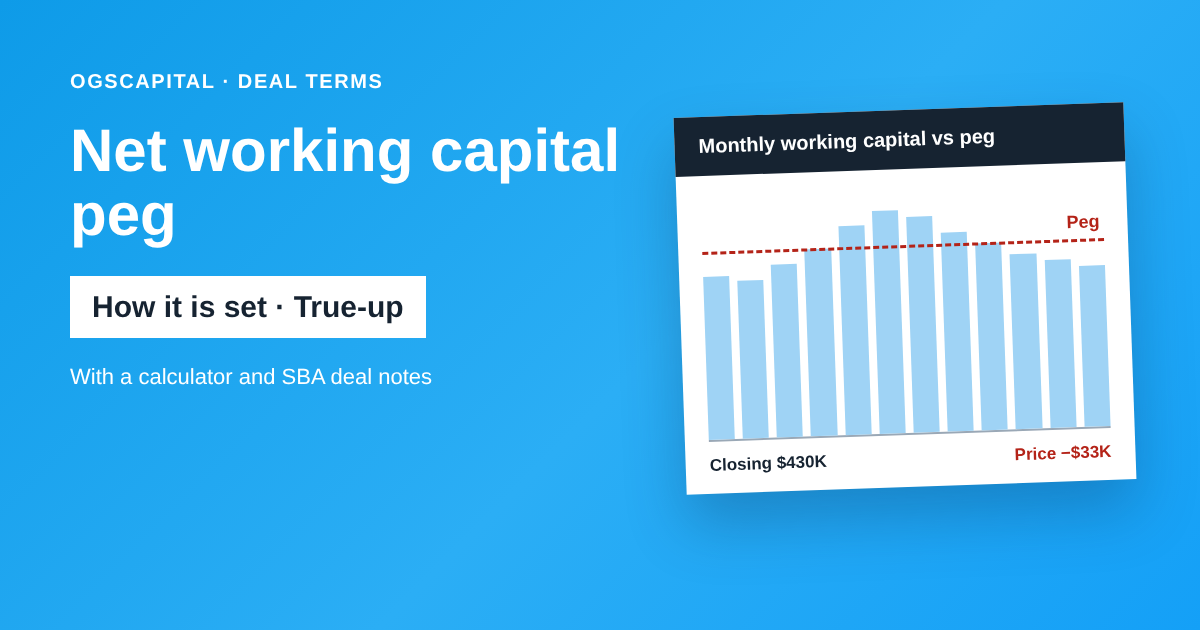
In cooling markets, receivables and equipment inventory climb from May to August and fall back by winter. A flat twelve-month average can cost one side money just because of the closing month. In this illustrative company, working capital runs from about $290,000 in February to $590,000 in July, with an average near $407K.
Net working capital at each month end, in thousands. Illustrative figures.
Close in February against the average and the seller owes about $117K for a normal winter dip. Close in July and the buyer owes about $183K. Two more HVAC details: customer deposits count as a current liability in the peg, and equipment bought early for summer installs should be checked against jobs that are actually booked. More on the mechanics: how the working capital peg is set.
See a real QoE bridge before you hire anyone
We will email you a redacted OGScapital quality of earnings report: the EBITDA bridge, each adjustment with its evidence, and the working capital analysis.
What to ask the seller for
Send this list right after the LOI is signed. Missing items are a finding in themselves.
- Monthly P&L and balance sheet for 24 to 36 months
- Bank statements for the same period
- Job reports from the field service app (ServiceTitan, Housecall Pro or similar) by job type
- List of maintenance agreements with price, start and renewal dates
- Customer deposits ledger and open install schedule
- Payroll by technician, with overtime and spiffs
- Contractor license holder and qualifier details
- Fleet list with year and mileage
- Warranty and callback log
- Manufacturer and distributor rebate statements
- Top 20 customers and any commercial contracts
- Owner’s add-back schedule with receipts
From OGScapital’s work: an acquisition holding company hired OGScapital for M&A advisory, financial due diligence and a valuation of an HVAC company it was buying. The work was completed in 30 days.
Client details are confidential. The client’s own review is on OGScapital’s Clutch profile.
Buying an HVAC company?
OGScapital prepares about 100 QoE reports a year for buyers, sellers and lenders. For an HVAC deal we split agreement and install revenue, test deposits and cut-off, price the owner’s replacement and set a seasonal working capital peg. Details: quality of earnings reports.
Under LOI on an HVAC company?
Tell us about the deal. We will send a QoE scope with one fixed price and a delivery date.
Prefer to talk? +1-619-727-5304
FAQ
Do I need a quality of earnings report to buy an HVAC company?
For an SBA-financed purchase price of $3 million or more, the lender needs one. Below that it is optional, but HVAC books are often cash basis with deposits and prepaid agreements booked as revenue, so a QoE usually changes the verified EBITDA.
What does a QoE look at in an HVAC business?
Revenue split between maintenance agreements, service and installs; customer deposits and install cut-off; prepaid agreement revenue; technician pay and overtime; the cost of replacing the owner and license holder; warranty callbacks, rebates and fleet age; and a seasonal working capital peg.
Are maintenance agreements counted as recurring revenue?
Only the part that renews. A QoE looks at how many agreements renewed last year and at what price, and recognizes prepaid agreements over the service period instead of when they are billed.
How are customer deposits treated?
A deposit for an install not yet done is a liability, not revenue. It comes out of EBITDA for the period and is counted in working capital, so the buyer is not paying for work it still has to do.
Does an HVAC contractor license transfer to the buyer?
Generally no. The buyer needs its own qualifier, often a licensed employee or the seller during a transition. The QoE prices that person into EBITDA; the license itself is a legal question for your attorney.
How is the working capital peg set for a seasonal HVAC company?
A flat twelve-month average can favor one side depending on the closing month. Many deals use the average for the closing month, or the same month last year, and count customer deposits as a current liability.
How long does a QoE for an HVAC company take?
OGScapital’s focused buy-side QoE takes about two weeks once the documents are in. A full-scope report takes longer, depending on how clean the books and job reports are.
How much does a QoE for an HVAC company cost?
At OGScapital, a focused buy-side QoE starts at $5,500 and a full-scope QoE at $10,000, with a fixed price agreed before work starts.