Share:


Table of Content
By Alex Silensky, Partner, and the OGScapital transaction advisory team (CPA, CVA) · Updated November 2026
SHORT ANSWER: THE QOE CAME IN LOWER. NOW WHAT?
Reprice on the verified number, then decide how to bridge what is left.
When a quality of earnings report finds lower EBITDA, the purchase price should move with it, because the business was priced as a multiple of earnings that turned out not to exist. Start from the same multiple on the QoE number. Then close the remaining gap with one of four tools: meet in the middle on findings that are judgment calls, a seller note, a payment tied to future results, or walking away. In SBA-financed deals two of these tools are limited: earnouts are not allowed, and a seller note counts toward your equity only on full standby.
In lower-middle-market M&A, purchase prices are retraded or restructured roughly 60% to 70% of the time after a buy-side QoE, typically with a 10% to 20% reduction in enterprise value. Sellers often present adjusted EBITDA built on cash-basis books and generous personal add-backs, and once accrual adjustments are applied, sustainable earnings almost always shift.
The fix is not a straight dollar-for-dollar cut. Apply the original multiple to the shortfall: a $500,000 drop in EBITDA at a 6x multiple is a $3 million price adjustment.
Alex Silensky, Partner, OGScapital
First, read what the gap is made of
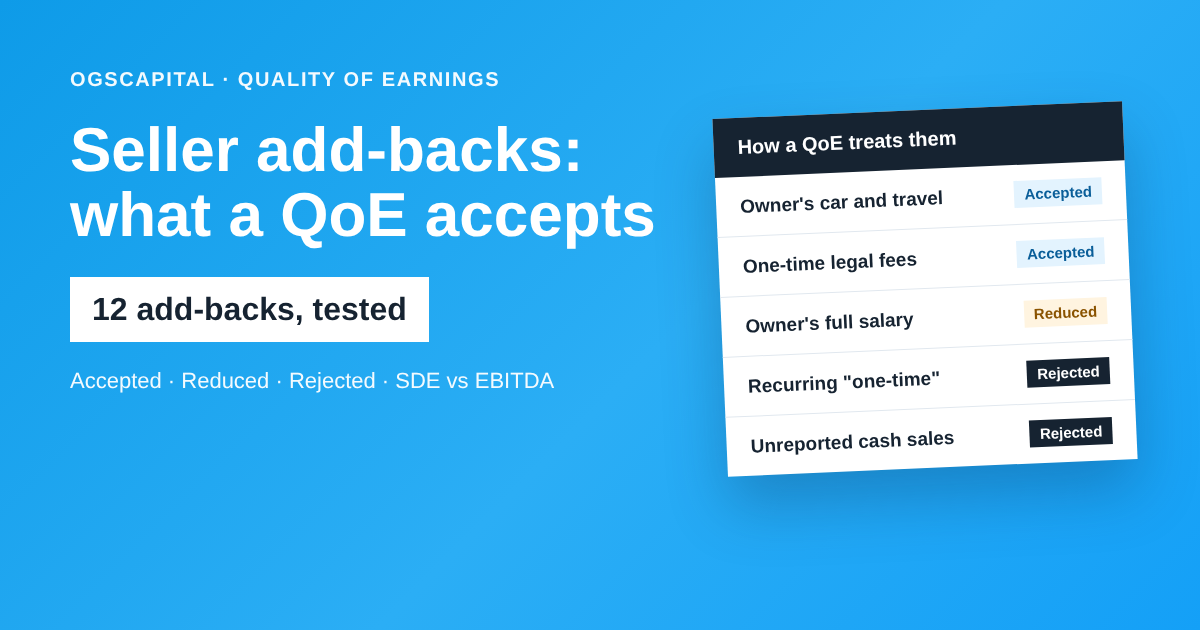
A lower number is not one problem. Before you call the seller, sort the QoE adjustments into the four groups below. Hard findings support repricing dollar for dollar. Judgment calls are where a compromise is reasonable. Timing fixes may not justify a price change at all. If you are not sure which add-backs usually survive, see which seller add-backs a QoE accepts.
Add-backs that did not hold up
No invoice, or the cost recurs every year. The seller’s number was never real, so this is the strongest case for repricing.
Revenue that will not repeat
A one-time order, a lost customer, cash sales outside the books. Run-rate earnings are lower, and the price should be too.
Normalizations
Market salary for the owner’s replacement, market rent, under-accrued bonuses. Real costs, but the amount is a benchmark you can negotiate.
Cut-off and accounting fixes
A sale booked in the wrong month or a one-off missed accrual can move the trailing twelve months without changing future earnings. A policy that books multi-year contracts upfront is different: it overstates every year, as in the case below.
Example: $900K claimed, $720K verified
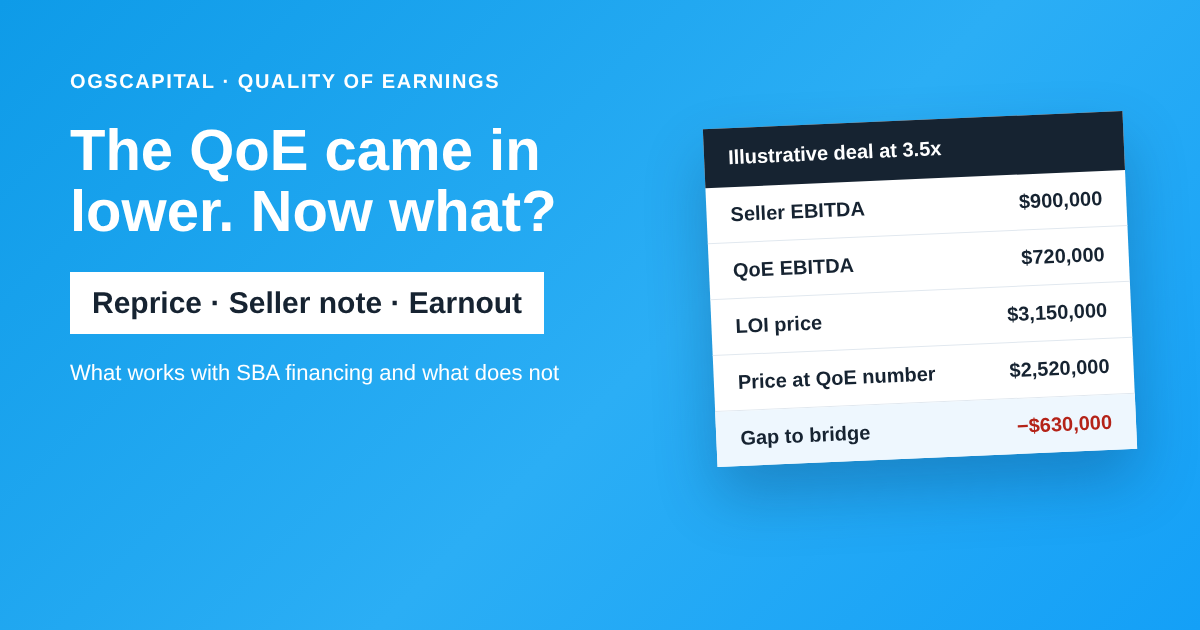
An illustrative deal. The LOI priced the business at 3.5x the seller’s adjusted EBITDA of $900,000, or $3,150,000. The QoE verified $720,000: $120,000 of add-backs did not hold up and $60,000 of one-time revenue came out. That is $180,000 less EBITDA and $630,000 less value at the same multiple.
| Option | Price | Paid how | Basis |
|---|---|---|---|
| Reprice at the same multiple | $2,520,000 | −$630,000 at closing | The QoE bridge, line by line |
| Meet in the middle | $2,835,000 | −$315,000 at closing | Hard findings fully, judgment calls split |
| Reprice + seller note | $2,835,000 | $2,520,000 at closing + $315,000 note | Seller is paid the rest over time |
| Earnout (non-SBA deals) | Up to $3,150,000 | $2,520,000 at closing + up to $630,000 if EBITDA recovers | Payment only if the business earns it |
The lender moves too. An SBA lender sizes the loan on cash flow, and for most change of ownership loans approved on or after October 1, 2026 the minimum debt service coverage is 1.25x. A price that still assumes $900,000 of earnings may simply not get financed.
FROM OUR QOE WORK · B2B SERVICES COMPANY
25% of EBITDA was timing and a missing liability
- What we found
- The seller booked multi-year contracts paid upfront as revenue on day one instead of over the service period, and had not recorded a liability for accrued employee bonuses. Together they made up about 25% of reported EBITDA.
- How it was resolved
- The business was otherwise healthy, so nobody walked away. The buyer cut cash at closing by $2.4 million, half of the 6x impact, and turned the other $2.4 million into a two-year seller note payable only if the business hit baseline EBITDA targets after closing.
“Never pay a premium multiple for earnings that don’t convert to cash. Use the QoE findings to shift the risk back to the seller through price reductions, earn-outs or seller financing.” — Alex Silensky
A note that depends on future EBITDA works like an earnout. In an SBA-financed deal, agree the structure with the lender first.
Your options, and when each one fits
1. Reprice at the same multiple
The default. The seller agreed to a multiple of earnings; the QoE shows what the earnings are. Send the bridge, not just the new number, so the seller sees every adjustment and the document behind it.
2. Meet in the middle
Take the hard findings in full and split the judgment calls, such as the market salary for a replacement manager or market rent.
3. Seller note for part of the price
The seller keeps the headline price closer to what they wanted, and you pay part of it over time, out of the cash flow the business actually produces.
4. Tie part of the price to future results
An earnout pays the seller more only if the business hits agreed targets after closing. It turns “we disagree about the earnings” into “let the earnings decide.”
5. Walk away
Sometimes the gap is the finding. Declining revenue the seller did not disclose, or earnings that only exist in cash nobody can trace, change the deal more than any price cut can fix.
Which options work with SBA financing
| Option | SBA 7(a) deal | Conventional or cash deal |
|---|---|---|
| Reprice at the same multiple | Yes | Yes |
| Seller note | Yes Counts as equity only on full standby, up to half of the 10% | Yes |
| Earnout | No | Yes |
| Seller note reduced if targets are missed | Lender decides | Yes |
| Walk away | Yes | Yes |
For SBA deals with a purchase price of $3 million or more, the lender now needs a QoE of its own. See SBA quality of earnings for $3M+ deals.
See how the bridge looks in a real QoE
We will email you a redacted OGScapital quality of earnings report: the EBITDA bridge, each adjustment and the evidence behind it, the page you would send a seller.
How to take the new number back to the seller
- 1Lead with the bridge, not the price.Walk through each adjustment and the document behind it. Sellers argue with conclusions, not with their own invoices.
- 2Separate hard findings from judgment calls.Say which items you will not move on and which you are open to discuss. It makes the compromise look like yours.
- 3Bring the lender in early.Ask what loan the verified EBITDA supports before you propose a structure the bank will not fund.
- 4Propose a structure, not just a cut.A lower price with a seller note, or a note reduced if targets are missed, is easier to accept than a bare number.
- 5Put it in writing and set a date.Amend the LOI with the new price and structure, and agree how long both sides have to sign.
Selling? A sell-side QoE finds these adjustments before a buyer does, when you can still fix them or price them in.
Negotiating after a QoE?
OGScapital prepares about 100 QoE reports a year. Every report includes a line-by-line EBITDA bridge you can put in front of a seller or a lender, and we can walk both through it. Details: quality of earnings reports.
Under LOI and the numbers do not add up?
Tell us about the deal. We will send a QoE scope with one fixed price and a delivery date, or a second look at a report you already have.
Prefer to talk? +1-619-727-5304
FAQ
What happens if a quality of earnings report finds lower EBITDA?
The buyer usually renegotiates. The cleanest approach is to apply the same multiple to the verified EBITDA, then close any remaining gap by splitting judgment calls, adding a seller note, tying part of the price to future results, or walking away.
Should the purchase price drop by the full EBITDA difference times the multiple?
For hard findings, such as add-backs that did not hold up or revenue that will not repeat, yes. For judgment calls like market salary or market rent, a compromise is common. Timing and cut-off fixes may not justify a price change.
Can I use an earnout in an SBA-financed acquisition?
No. Earnouts are not allowed in SBA 7(a) acquisitions. Some lenders accept a seller note that is reduced if agreed targets are missed; ask your lender before you propose it.
Can a seller note count toward the SBA equity injection?
Only if it is subordinated and on full standby, with no principal or interest payments for the life of the SBA loan, and only for up to half of the required 10% injection.
Does a lower QoE number affect the SBA loan amount?
Yes. The lender sizes the loan on verified cash flow. For most change of ownership loans approved on or after October 1, 2026, the minimum debt service coverage is 1.25x.
What if the seller refuses to lower the price?
Ask which findings they dispute and what evidence they have. If they cannot support the original number and will not move, the QoE has done its job: it stopped you from overpaying.
How often is the price changed after a QoE?
In lower-middle-market M&A, purchase prices are retraded or restructured roughly 60% to 70% of the time after a buy-side QoE, typically with a 10% to 20% reduction in enterprise value, according to OGScapital partner Alex Silensky.
How much lower does EBITDA usually come in?
In OGScapital’s QoE work, adjusted EBITDA comes in about 20% below what the seller reported on average, mostly from add-backs that do not hold up.
Can the seller challenge the QoE?
Yes, and a good QoE makes that easy: each adjustment is listed with the document behind it, so the discussion is about evidence, not opinions.