Share:


Table of Content
Reviewed by Alex Silensky, Partner, and the OGScapital CFO team · Updated November 2026
SHORT ANSWER: WHAT TO DO WITH THE FINANCES AFTER CLOSING
Control the cash first. Then the close. Then the plan.
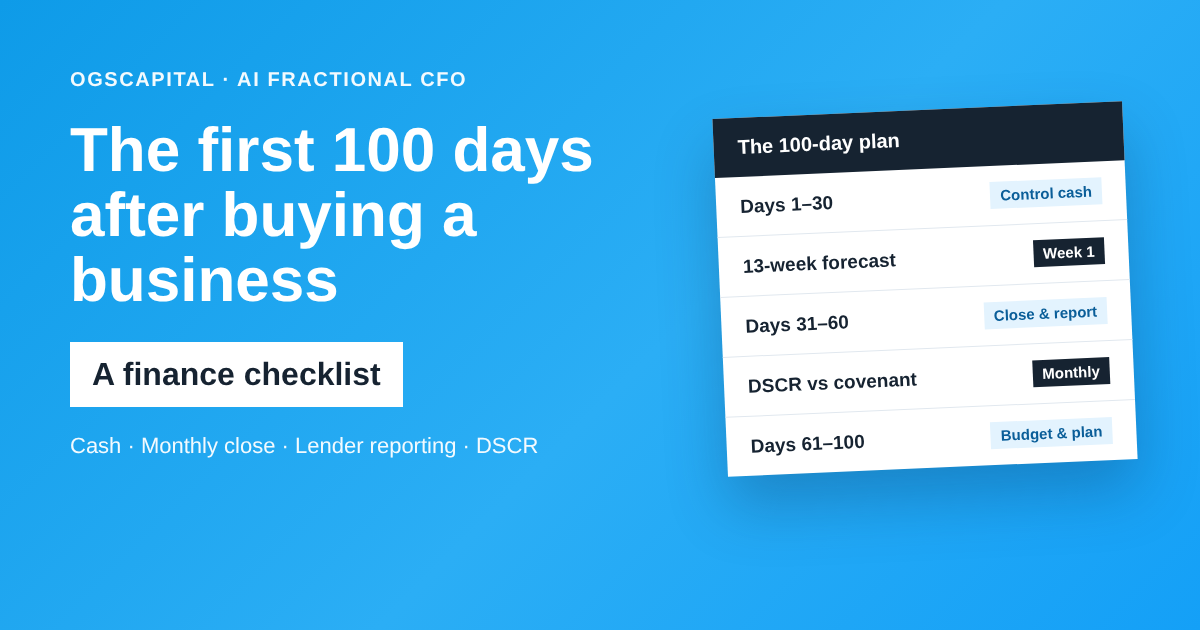
In the first 100 days after buying a small business, take control of bank accounts and payments and build a 13-week cash forecast in week one. By day 60, close the books monthly on an accrual basis, set up the reporting your lender expects and track your debt service coverage ratio (DSCR) against the covenant. By day 100, have a budget built on the QoE-adjusted earnings, not the seller’s, with early-warning triggers for cash and DSCR. Most new owners of $2M–$50M businesses do this with a bookkeeper plus a fractional CFO rather than a full-time hire.
Why the finance function breaks after closing
The seller often ran the business on cash-basis books, a few spreadsheets and memory. The day you close, three things change: you carry acquisition debt, your lender expects regular financial reporting, and you no longer know where every dollar goes. Problems in the first months are usually not about the business. They come from not seeing the cash in time.
The 100-day finance checklist
Fifteen tasks in three phases. Phase one cannot wait; phases two and three can overlap.
Take control of the cash
- Bank accounts, signatories and payment approvals moved to you
- Payroll, payroll tax and sales tax accounts transferred
- 13-week cash forecast built and updated every week
- Working capital true-up with the seller settled against the peg
- Debt calendar: SBA loan, seller note and every payment date
Close the books and report
- Chart of accounts cleaned up; books moved to accrual
- Monthly close in about 10 business days, not three weeks
- Reporting pack your loan agreement requires, on schedule
- DSCR tracked monthly against the covenant
- A short KPI dashboard: cash, margin, receivables, top customers
Plan and improve
- Budget for the year built on QoE-adjusted EBITDA
- Margin review by product, customer and channel
- Early-warning triggers for cash, DSCR and customer concentration
- Decide the finance team you need: bookkeeper, controller, CFO
- Plan the first year-end close and tax filing
Track DSCR before your lender does
Debt service coverage ratio is the cash flow available for debt service divided by your annual loan payments. The SBA underwrites acquisition loans at a minimum of 1.25x, and your loan agreement may set its own covenant. A small drop in earnings can push you below it. A simplified example:
Track it monthly on a rolling 12-month basis, with a trigger well above the covenant, so there is time to act: delay capital spending, collect receivables faster or talk to the lender early.
Who should run the finances after you buy
| Option | Cost | What you get |
|---|---|---|
| Do it yourself | Owner time | Works for very small businesses; the owner becomes the finance team on top of running the company. |
| Bookkeeper only | Monthly fee | Records the past; no forecast, DSCR tracking or decision support. |
| Traditional fractional CFO | $3k–$12k a month | Senior judgment; numbers are built by hand, so they often arrive late. |
| AI fractional CFO | from $2,500 a month at OGScapital | A platform closes the month and forecasts cash; a senior CFO checks, signs off and advises. |
| Full-time CFO | Full salary and benefits | Makes sense once the business needs a finance leader every day. |
A traditional fractional CFO is the better choice when you need someone on site, run several entities or are raising equity from investors. An AI fractional CFO fits most owner-run businesses with $2M–$50M of revenue: you need fast monthly numbers, a live cash forecast and lender reporting without paying for hours of manual work. How the OGS AI fractional CFO works.
What this looks like in practice
Two OGScapital AI fractional CFO clients, shared without names.
Manufacturing and distribution · $18M revenue
Cash gap avoided at the seasonal peak
- Problem
- Orders were steady, but cash was tied up in inventory and receivables. The books closed three weeks late, and spreadsheets could not show whether there was enough cash for raw materials and payroll.
- What we did
- The OGS AI Platform was connected to the accounting system, sales and bank accounts. It sped up the close, built a live 13-week cash forecast and flagged a cash dip a month ahead, caused by large supplier payments falling together.
- Result
- The OGS CFO ran scenarios, renegotiated payment terms with key suppliers and customers and rescheduled capital spending. The company passed its seasonal peak with no overdraft or new credit line and now reviews liquidity weekly.
E-commerce and retail · $25M revenue
Operating margin from 13% to over 30%
- Problem
- Revenue grew, but profit stayed flat. The budget never matched the actuals, and marketing channels were eating the margin.
- What we did
- In one week the platform reconciled sales and cost data and showed that rising acquisition costs on paid social and high churn were cancelling out revenue growth.
- Result
- The OGS CFO modeled scenarios, repriced products, cut unprofitable ad channels and reduced overheads. Operating margin rose from 13% to over 30% in two quarters, and the board now gets reconciled reports on time.
Did your QoE with us? Start on day one
After a quality of earnings report, we already know the business: the adjusted EBITDA, the add-backs, the working capital and the customers. Your CFO starts from that model instead of collecting the same data again, and QoE clients get a discount on the CFO engagement. We track DSCR against your covenant and prepare the reporting your SBA lender expects.
AI CFO Advisor from $2,500 a month; a dedicated OGS CFO from $4,500 a month. First diagnosis and 90-day plan within a week.
PLAN MY FIRST 100 DAYSJust bought a business, or about to?
Tell us where you are. We will send a 100-day finance plan outline and what an AI fractional CFO would cost for your business.
Prefer to talk? +1-619-727-5304
FAQ
What should I do with the finances in the first 100 days after buying a business?
In the first 30 days, take control of bank accounts and payments and build a 13-week cash forecast. By day 60, close the books monthly on an accrual basis, set up lender reporting and track DSCR against your covenant. By day 100, build a budget on the QoE-adjusted earnings and set early-warning triggers.
Do I need a CFO after buying a small business?
Not a full-time one in most cases. Owners of $2M–$50M businesses usually pair a bookkeeper with a fractional CFO for cash forecasting, lender reporting and decisions, and hire full-time only once the business needs a finance leader every day.
How much does a fractional CFO cost?
Most fractional CFO retainers run about $3,000–$12,000 a month. OGScapital’s AI fractional CFO starts at $2,500 a month for the advisor plan and $4,500 a month with a dedicated CFO, plus a one-time setup fee that depends on the business.
What is an AI fractional CFO?
A fractional CFO service where an AI platform connects your accounting, sales and bank data, closes the month and forecasts cash and profit, while a senior CFO checks the numbers, signs off and advises on decisions.
How do I track DSCR after an SBA acquisition?
Divide cash flow available for debt service by annual loan payments, on a rolling 12-month basis, every month. Compare it with the covenant in your loan agreement and set an internal trigger above it so you have time to act.
When should I switch the books from cash to accrual?
In the first 30–60 days. Accrual books match revenue and costs to the right months, which your lender, your budget and your DSCR tracking all depend on.
What reporting will my SBA lender expect after closing?
It depends on your loan agreement: usually annual financial statements and tax returns, and sometimes interim statements or covenant certificates. Read the reporting section of the agreement in week one and put every due date on a calendar.
Can OGScapital use my QoE to start the CFO work?
Yes. If we prepared your quality of earnings report, your CFO starts from that model without collecting the data again, and QoE clients get a discount on the CFO engagement.