Share:


Table of Content
By Alex Silensky, Partner, and the OGScapital transaction advisory team (CPA, CVA) · Updated November 2026
SHORT ANSWER: WHAT A QOE CHECKS IN A RESTORATION COMPANY
What the carriers actually paid, not what was billed.
Most of a restoration company’s revenue is paid by insurance carriers, often months after the job, and often for less than the estimate. A quality of earnings report rebuilds revenue on what was collected, tests old insurance receivables, takes out storm years that will not repeat, checks reconstruction jobs that were billed ahead of the work, and looks at how much of the business depends on one carrier, one TPA program or the owner’s relationships with adjusters. That is where a seller’s EBITDA usually comes apart.
Six places where restoration numbers mislead
Restoration owners usually know their jobs well and their books less well. Many run on cash-basis accounting, estimate in Xactimate and track jobs in a separate system. These are the lines we test first.
Billed vs collected
Jobs are invoiced on an estimate, then carriers and TPAs adjust it. If revenue is booked at the full estimate, earnings run ahead of cash. The gap between invoiced and collected, job by job, is the first test.
Insurance receivables
Claims sit in receivables for months. The older a claim, the less of it is usually paid. Receivables past six months need a reason to be counted at full value.
Storms and one-off events
A hurricane, freeze or wildfire season can lift a year’s revenue far above normal. A buyer should pay for the normal year, with the storm year shown separately.
Mitigation vs reconstruction
Water mitigation is fast and high margin. Reconstruction is slower, lower margin and often billed in stages. Jobs billed ahead of the work inflate revenue in the period.
Subcontractors and cut-off
Reconstruction leans on subs. Invoices for finished jobs that arrive after year end, or are paid in cash, are costs the seller’s numbers can miss.
Carriers, TPAs and referral sources
Preferred vendor programs, TPA networks and relationships with adjusters and agents drive the work. If one carrier or program is a large share of revenue, or the relationships belong to the owner, the run-rate is at risk.
Example: a restoration company with $1.05M of seller EBITDA
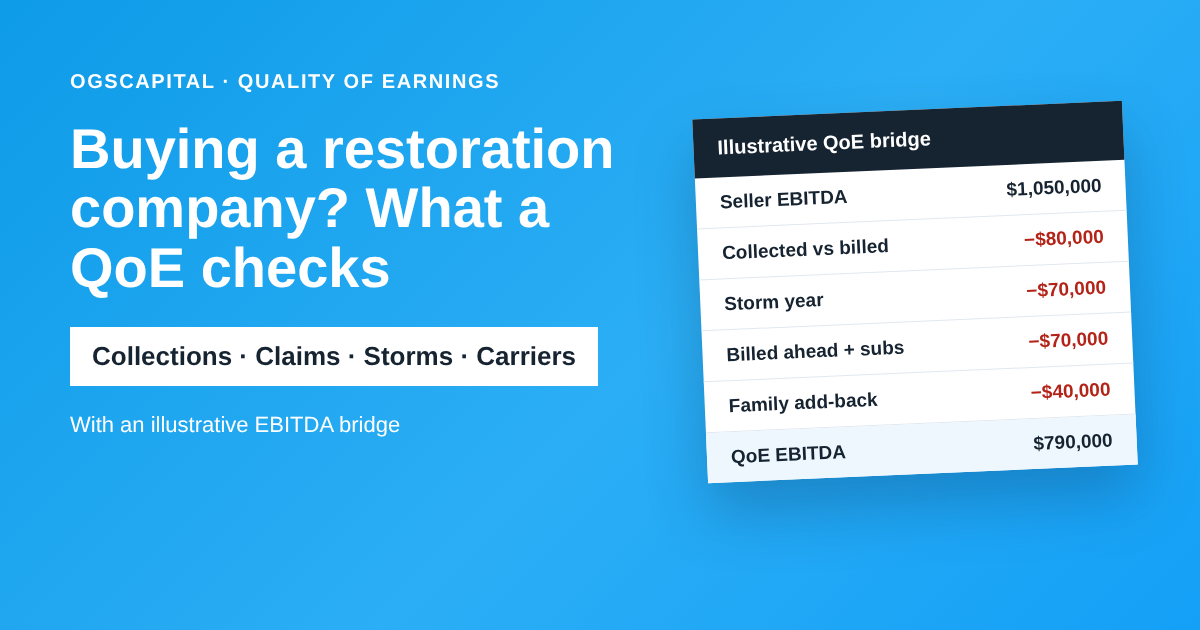
A water and fire mitigation company with a reconstruction arm, about $5.5 million in revenue and most of it paid by insurance carriers. The LOI priced it at 4.5x the seller’s adjusted EBITDA of $1,050,000, or $4,725,000. This is how a QoE bridge for a business like this often looks.
| Line | Amount | Type |
|---|---|---|
| Seller’s adjusted EBITDAAs presented in the broker package | $1,050,000 | |
| Revenue at collected valueRevenue was booked at invoiced amounts. Carriers paid less than invoiced on closed claims, and the same rate was applied to open ones. | −$80,000 | Hard |
| Storm year normalizationA freeze event added a quarter of work well above normal. The excess margin is shown separately, not in run-rate. | −$70,000 | Judgment |
| Reconstruction billed aheadTwo rebuild jobs were billed in stages ahead of the work done at year end. | −$40,000 | Timing |
| Subcontractor cut-offSub invoices for finished jobs arrived after year end and were not recorded. | −$30,000 | Hard |
| Family payroll add-backThe owner’s relative coordinates with adjusters full time. The add-back was rejected. | −$40,000 | Hard |
| QoE EBITDAVerified, on an accrual basis | $790,000 |
Hypothetical figures, built from patterns that are common in restoration deals. They do not describe any OGScapital client.
$260,000 less EBITDA at the same 4.5x is $1,170,000 less value: $3,555,000 instead of $4,725,000. The storm year is where the real argument is: the seller will say storms happen every year, the buyer will say this one was bigger than most. Three to five years of monthly revenue usually settle it. For how to take a lower number back to the seller, see what to do when the QoE finds lower EBITDA.
Financing. At a purchase price of $3 million or more, an SBA lender now needs a QoE of its own, and for most change of ownership loans approved on or after October 1, 2026 it looks for at least 1.25x debt service coverage on verified cash flow. Details: SBA quality of earnings.
Results from real restoration deals
The example above is illustrative. These are real: what our clients said in verified reviews on Clutch. Deal figures stay confidential.
FROM OUR WORK · VERIFIED CLIENT REVIEW
Why the seller’s numbers and ours did not match
- Client
- MBV, a restoration and reconstruction business in San Diego, buying a small restoration company
- The task
- A quality of earnings report before closing
- What we did
- Tested the seller’s P&L against bank statements, invoices, CRM data and tax returns. The business was set up in a complex way, so the work became a full reconciliation with forensic analysis
- Result
- The buyer understood exactly where the seller’s report and our numbers differed, and decided to go ahead with the deal
“They had great communication and were very responsive.”
Maitreyi Chaganti, Owner, MBV · Verified review on Clutch
FROM OUR WORK · VERIFIED CLIENT REVIEW
QoE on a fire and water mitigation company for a PE buyer
- Client
- Syndicate Venture Group, a private equity firm, evaluating a mitigation company for a client
- The task
- A buy-side quality of earnings report from the target’s QuickBooks data
- Result
- A detailed report, delivered faster than expected, that supported the acquisition decision
“They handled everything to great satisfaction.”
Renan Cortez, CEO, Syndicate Venture Group · Verified review on Clutch
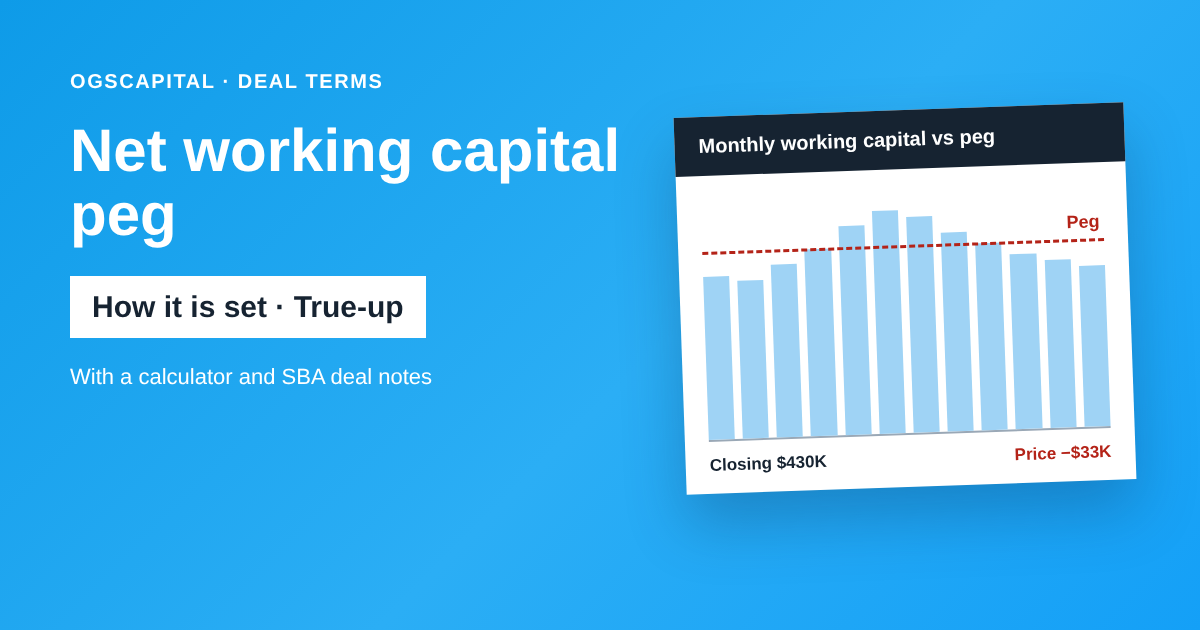
Insurance receivables and the working capital peg
In restoration, receivables are most of working capital, so the way they are counted decides the peg. A buyer who takes on old claims at face value pays for cash that may never come. The illustrative aging below shows how a QoE usually treats each bucket.
| Age of claim | Balance | Typical treatment |
|---|---|---|
| 0–30 days | $310,000 | Counted at expected collection rate |
| 31–90 days | $260,000 | Counted at expected collection rate |
| 91–180 days | $150,000 | Tested claim by claim |
| 181–365 days | $90,000 | Usually reserved in part or left with the seller |
| Over 1 year | $40,000 | Usually excluded |
Illustrative figures, $850,000 of receivables in total.
Two common fixes: leave claims older than six months with the seller, who keeps whatever they later collect, or set the peg on receivables at their expected collection value. Either way, agree it in the LOI. More on the mechanics: how the working capital peg is set.
See a real QoE bridge before you hire anyone
We will email you a redacted OGScapital quality of earnings report: the EBITDA bridge, each adjustment with its evidence, and the working capital analysis.
What to ask the seller for
Send this list right after the LOI is signed. If the seller cannot produce collected amounts by job, that is a finding in itself.
- Monthly P&L and balance sheet for 36 months
- Bank statements for the same period
- Job list with estimate, invoiced and collected amount per job
- Receivables aging by carrier and by claim
- Revenue by carrier, TPA program and referral source
- Revenue split between mitigation and reconstruction
- Open jobs with billing to date and percent complete
- Subcontractor list and invoices after year end
- Payroll by employee, including family members
- Equipment list and IICRC certifications by technician
- Preferred vendor and TPA agreements
- Owner’s add-back schedule with receipts
Buying a restoration company?
OGScapital prepares about 100 QoE reports a year for buyers, sellers and lenders. For a restoration deal we rebuild revenue on collected amounts, test insurance receivables claim by claim, normalize storm years and check carrier concentration. Details: quality of earnings reports.
Under LOI on a restoration company?
Tell us about the deal. We will send a QoE scope with one fixed price and a delivery date.
Prefer to talk? +1-619-727-5304
FAQ
Do I need a quality of earnings report to buy a restoration company?
For an SBA-financed purchase price of $3 million or more, the lender needs one. Below that it is optional, but restoration revenue is often booked at invoiced amounts that carriers later reduce, so a QoE usually changes the verified EBITDA.
What does a QoE look at in a restoration business?
Revenue at collected rather than invoiced value; insurance receivables by age and carrier; storm or catastrophe years; mitigation vs reconstruction margins and jobs billed ahead of the work; subcontractor cut-off; carrier, TPA and referral concentration; and owner and family add-backs.
How are old insurance receivables treated?
Recent claims are usually counted at the expected collection rate. Claims older than six months are tested one by one and are often reserved, excluded from the peg, or left with the seller, who keeps whatever is later collected.
Should storm revenue count in EBITDA?
Normal seasonal storm work, yes. A single large event that lifted one year well above the others is usually shown separately and taken out of run-rate EBITDA. Three to five years of monthly revenue show what normal looks like.
What if one carrier or TPA program brings most of the work?
It is a risk to price, not always a deal breaker. A QoE shows revenue by carrier and program, and the buyer checks whether preferred vendor status and program agreements continue after the sale.
How is the working capital peg set for a restoration company?
Receivables dominate working capital, so the peg depends on how they are counted. Common approaches are to value receivables at expected collection, or to leave claims older than about six months with the seller.
How long does a QoE for a restoration company take?
OGScapital’s focused buy-side QoE takes about two weeks once the documents are in. Job-level data on invoiced and collected amounts is what most often slows it down.
How much does a QoE for a restoration company cost?
At OGScapital, a focused buy-side QoE starts at $5,500 and a full-scope QoE at $10,000, with a fixed price agreed before work starts.