Share:


Table of Content
If you search “business plan consultant vs business plan writer”, you’ll find a lot of vague takes. The simplest way to understand it is this:
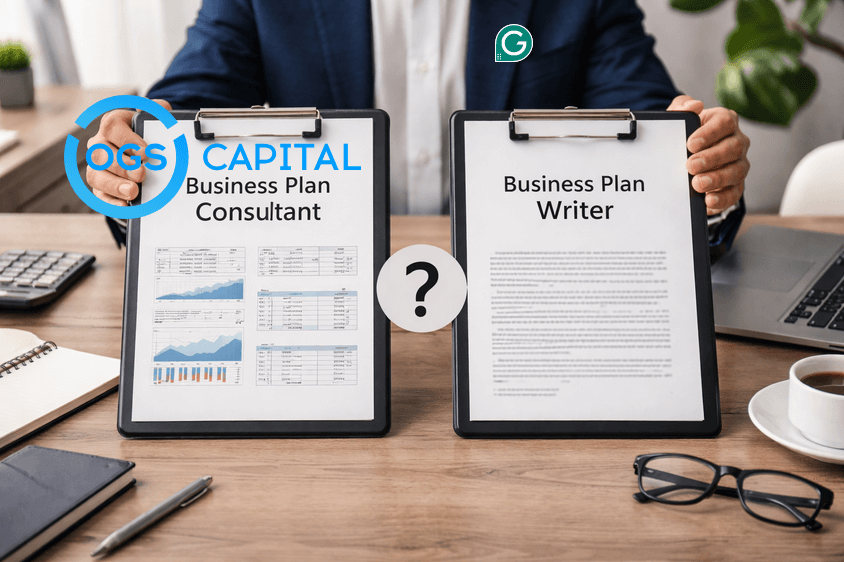
A business plan writer helps you turn your information into a clean, readable, well-structured plan. A business plan consultant helps you make sure the plan is true, defensible, and built on assumptions that hold up when someone challenges them.
Both matter. But they solve different problems.
Here’s the definition that actually helps you choose:
- Writer = communication and structure. The plan reads well. The story is clear. The sections are in the right order. The executive summary lands. The document looks like something a lender or investor expects to see.
- Consultant = decision-grade logic. The plan makes sense as a business. The strategy is coherent. The market logic is realistic. The numbers connect to real drivers. The risks are named and handled, not ignored.
People often hire the wrong role because they misdiagnose the pain.
They think, “My plan doesn’t work, so I need better writing”. But sometimes the writing is fine. The real issue is that the math doesn’t tie out, the customer story is soft, or the go-to-market plan is not credible.
And sometimes it’s the opposite. The business logic is solid, but the plan is hard to read. It’s disorganized, inconsistent, and unclear. So the reader stops early or misses the point.
Why this choice affects funding outcomes
Investors and lenders don’t “grade” your plan like a school essay. They use it to answer a few questions fast:
- Do i understand the business in 2–3 minutes?
- Do the assumptions sound real?
- Do the numbers match the story?
- Do i believe this team knows what they’re doing?
- Is the risk profile acceptable for this kind of money?
A business plan can be well-written and still fail if the logic is weak. It can also be logically sound and still fail if it’s confusing, messy, or doesn’t match the audience (bank vs investor vs internal use).
So the point of this article isn’t to argue which role is “better”. It’s to help you pick the one that fits your situation, and avoid paying twice.
And yes, there are cases where the best move is to work with a team that can provide both business plan consulting and business plan writing services, because the handoff between logic and writing is where many plans break.
What each role actually does: tasks and deliverables
Titles get abused in this space. Some people call themselves consultants but only rewrite text. Others call themselves writers but build full financial models. That’s why it’s better to focus on responsibilities and outputs, not labels.
Below is the practical breakdown.
What a business plan writer is responsible for
A good writer’s job is to make your plan easy to understand and hard to misread.
Typical responsibilities include:
- Document structure and flow. Putting sections in a logical order. Making sure each section answers the next natural question.
- Clarity and consistency. One voice, one story, one set of terms. No contradictions between sections.
- Executive summary writing. Not a “summary of the document”, but a tight case for why the business makes sense.
- Business plan formatting. Professional layout, clean visuals, readable tables, consistent headings. The plan looks lender/investor-ready.
- Business plan revision and editing. Taking a rough draft and turning it into a coherent plan without changing the underlying business logic.
What a writer usually should not be expected to do (unless explicitly agreed):
- Create your go-to-market strategy from scratch.
- Validate market assumptions with real research.
- Build a driver-based financial model if you don’t have inputs.
- Fix a broken business narrative (where the business itself doesn’t make sense yet).
A writer can help you communicate. But they can’t “write you into” a viable strategy.
What a business plan consultant is responsible for
A consultant’s job is to pressure-test the business and make the plan hold up under scrutiny.
Typical responsibilities include:
- Business strategy. Clarifying how the business wins: target customer, positioning, pricing logic, channels, and why this is defensible.
- Market validation. Making sure the market narrative isn’t built on wishful thinking. Stress-testing demand and competition claims.
- Assumptions and drivers. Defining what must be true for the plan to work. Calling out the biggest swing factors.
- Financial model development or rebuild. Connecting revenue and costs to real operating drivers (not just flat growth rates).
- Funding logic. Aligning the plan with what the capital is for (use of funds), what milestones it buys, and what outcomes it should produce.
What a consultant usually should not be expected to do by default:
- Turn raw notes into polished writing without a writer/editor involved.
- Spend most of the engagement on formatting and copyediting.
- “Guarantee funding”. No serious consultant promises this.
Where responsibilities overlap
There is overlap in the middle. Both roles touch the narrative. Both care about clarity. Both should notice obvious inconsistencies.
But they approach it differently:
- A writer asks: “Does the reader understand this quickly?”
- A consultant asks: “Is this true, and does it hold up if challenged?”
Here’s a simple way to compare deliverables. It’s not perfect, but it’s practical:
| Area | Business plan writer deliverables | Business plan consultant deliverables |
|---|---|---|
| Narrative | Clear story, strong flow, clean executive summary writing | Credible strategy, tight logic, explicit assumptions |
| Document | Professional business plan formatting, consistent structure | Decision-grade content and arguments |
| Numbers | Clean presentation of provided numbers | Financial model creation/rebuild, driver logic, sensitivity thinking |
| Risk | Clear wording and mitigation section | Real risk identification, trade-offs, “what breaks the model” |
| Goal | Make the plan readable and credible on the page | Make the plan defensible in a conversation |
If you’re not sure which one you need, don’t start with the title. Start with the question: what’s currently failing? Is it comprehension and presentation, or is it credibility and logic?
At OGScapital, this is usually where we start too. We look at what you already have, identify whether the issue is writing, business logic, or both, and then build the right workflow so you don’t pay for rework.
When you need a business plan writer: 7 common scenarios
If your plan is logically solid but still not getting traction, it’s tempting to assume “investors hate my business”. Sometimes they do. But often the simpler truth is that the plan is hard to read, hard to skim, or doesn’t match the audience.
Here are situations where it makes sense to hire a business plan writer first (or at least include a writer early).
1) You already have solid numbers and assumptions
You have realistic inputs. You can explain how you make money. You know your pricing and costs. You have a basic model that ties out.
But the plan is still messy. It repeats itself. It’s unclear what matters. A professional business plan writer can turn strong raw material into a plan that reads like a funding document, not a brainstorm.
2) You need structure, clarity, and audience-fit
A lender reads differently than an investor. An internal plan reads differently than a pitch document.
If your content is fine but the plan doesn’t match the reader’s expectations, you lose attention fast. A writer helps you shape the plan for the audience:
- bank-focused structure and risk framing
- investor-focused clarity on growth logic and milestones
- internal plan clarity around execution and operating priorities
This is one of the highest-ROI uses of writing, because it prevents “good content in the wrong wrapper”.
3) You need speed without rebuilding the business logic
Sometimes you’re not trying to reinvent the business. You just need a clean document for a deadline. Maybe it’s a loan application window, a partner request, or an internal board packet.
If the business logic is already defined, writing is the lever that saves time. The key is to be honest about that. Don’t pay for strategy work if the strategy is already done and defensible.
4) You have a messy draft that needs professional packaging
A common situation: you wrote the plan yourself, or stitched it together from different docs. The content is there, but the quality signals are bad:
- inconsistent voice
- sloppy formatting
- contradictions between sections
- outdated numbers in one part of the plan
- an executive summary that doesn’t match the rest
This is classic business plan revision and business plan editing territory. And it matters more than people think. A plan that looks rushed makes the business look rushed.
5) You’re getting “unclear” feedback, not “this is wrong”
If the pushback you’re getting sounds like this:
- “I’m not sure i follow”.
- “This feels confusing”.
- “Can you clarify what you do and who it’s for?”
- “This is too long / too dense”.
- “I didn’t get to the numbers”.
That’s usually a writing/structure issue, not a strategy failure. A writer fixes comprehension gaps and makes the plan skimmable without killing substance.
6) The business is simple, but the plan reads complicated
Some businesses are straightforward. Local services, simple B2B offers, single-product e-commerce with proven demand.
If the plan reads like a thesis, you’re creating friction for no reason. A writer can cut it down, simplify the language, tighten the narrative, and keep it credible.
7) You need a strong executive summary because that’s what gets read
A lot of decisions get made before someone reads page 2. If your executive summary is weak, your plan might never get a real chance.
Executive summary writing is not “summarising the plan”. It’s the case for why the plan is worth reading. If you have a good business but a weak summary, you’re losing at the top of the funnel.
When you need a business plan consultant: 7 common scenarios
A business plan writer can make a plan clear. But a business plan consultant is what you hire when the plan needs to be defensible. Not prettier. Defensible.
If you’re asking “when to hire a business plan consultant”, these are the situations where it usually makes sense.
1) Your business logic isn’t defensible yet
You might have a strong idea. But when someone asks basic questions, the answers don’t hold up.
Things like:
- why customers will switch
- why pricing works
- why CAC won’t explode
- why margins are real, not optimistic
- why your growth path is realistic
This is not a writing problem. This is a logic problem. A consultant helps you tighten the strategy and make the story match real constraints.
2) Your financial projections don’t tie to real drivers
A common issue: the spreadsheet grows because someone typed “+15% monthly”. But there is no operating driver behind it.
A consultant will usually rebuild or pressure-test financial projections so they connect to:
- lead volume and conversion
- sales cycle length
- capacity and delivery constraints
- churn / retention
- hiring plan and ramp time
- COGS and margin realities
If the model can’t explain why numbers move, investors and lenders treat it like fiction. Even if it looks clean.
3) You need market sizing, pricing logic, and a real go-to-market strategy
A lot of plans say “the market is $50B” and stop there. That’s not market sizing. That’s a Google number.
A consultant helps you build a go-to-market strategy that answers:
- who you sell to first (and why)
- what channel actually fits your budget and sales motion
- what pricing structure makes sense (and what it implies for margins)
- what your wedge is, and what makes it credible
This is where unit economics comes in. If the unit economics are shaky, the plan won’t survive questions. A good consultant forces the plan to face reality early, before you burn months pitching a broken narrative.
4) You’re getting investor or bank pushback and don’t know why
This is one of the most common founder pains:
“I sent the plan. Nobody replied.”
or
“The bank asked for more info, then went quiet.”
Silence is usually a signal, not a mystery. Most of the time it’s one of these:
- assumptions feel ungrounded
- the model doesn’t reconcile
- the use of funds is vague
- the plan doesn’t match the audience (bank vs investor)
- risk is ignored or hand-waved
- the economics don’t work at the unit level
A consultant can diagnose what’s actually failing and what needs to change. Not as “edits”, but as a fix to the decision logic.
5) You need to align the plan with a real funding ask
A plan that says “we’re raising $1.5M” but can’t show what that money buys is a fast no.
A consultant helps connect the ask to:
- milestones (product, revenue, distribution)
- hiring plan and timing
- burn and runway
- scenario planning (what if revenue is slower)
This is also where a “funding-ready business plan” differs from a generic plan. It has a specific funding logic, not just a big vision.
6) You’re entering a high-stakes moment (launch, expansion, acquisition, franchising)
If the plan is going to be used for something that has consequences, you want the logic to be tight.
Examples:
- expanding to a new market
- adding a new product line
- buying equipment and taking on debt
- rolling out a franchise model
- getting ready for due diligence
A consultant helps you map risks and trade-offs, and build a plan that can support real decisions, not just marketing.
7) You have internal disagreement and need a plan that resolves it
This one is underrated. If the founders or leadership team are not aligned, a written plan won’t solve it. It just documents confusion.
A consultant can help force clarity:
- what you’re prioritizing
- what you’re not doing
- what must be true for the plan to work
- what the team will measure
That’s not “writing help”. That’s strategy and operating alignment.
If you’re reading these and thinking “yeah, that’s me”, you probably don’t need more formatting. You need someone who can build and defend the logic behind the plan. That’s what business plan consulting is supposed to do.
At OGScapital, this is often where we start: we look at your current plan or draft, identify what’s breaking (logic, model, audience fit, or all three), and then choose the right workflow so you don’t redo the whole document twice.
Diagnostic: is the problem writing or business logic?
Most people waste money because they choose the role before they diagnose the problem.
So here’s a simple diagnostic you can run on your own. It won’t be perfect. But it’ll get you close.
Signs you mostly need a writer
If most of these are true, a business plan writer is usually the right first move:
- You can explain the business clearly in a conversation.
- Your pricing and costs are known and stable.
- Your model ties out and you trust the inputs.
- The feedback you get is “unclear”, “too long”, “hard to follow”.
- People ask basic “what do you do?” questions after reading.
- Your executive summary doesn’t match the rest of the plan.
- The plan repeats itself and feels disorganised.
- You’ve got too many versions and inconsistencies.
- The plan doesn’t feel tailored to the reader (bank vs investor).
- You feel like the plan is accurate, it just doesn’t land.
This is where business plan writing services and revisions pay off. The logic is there. It just needs to be communicated like a professional document.
Signs you mostly need a consultant
If these show up, you’re in business plan consultant territory:
- Your growth is a generic percentage, not a driver-based build.
- CAC, conversion, churn, or sales cycle assumptions are guesses.
- Revenue and costs are not connected to real operations.
- You can’t explain what would break the model.
- You’re unsure about pricing logic and margins.
- Investors or lenders question “how you know” your numbers.
- You can’t clearly justify the use of funds and milestones.
- The TAM slide is big, but the initial market is unclear.
- Your plan looks good but gets ignored (or dies after first contact).
- When someone pushes, you end up saying “we’ll figure it out”.
These are not writing issues. These are business plan assumptions, model integrity, and strategy issues. A consultant helps you build something that can survive scrutiny.
The “Question Stress Test” (what investors and lenders probe first)
If you want a fast test for whether your plan is funding-ready, answer these in plain English. If you struggle, that’s a clue.
- Who is the first buyer, and why do they buy now?
- What is your price, and why is that the right price?
- What is your acquisition path, and what does it cost?
- What are your unit economics, and what makes them improve over time?
- What’s the biggest risk, and what would you do if it happens?
- What does the funding specifically unlock, and by when?
- Why you, and why this team can execute?
This is why “why investors reject business plans” is often a logic problem. Investors and lenders don’t reject because a sentence is awkward. They reject because the plan doesn’t answer these questions cleanly, or the answers don’t feel real.
If your answers are solid but the plan doesn’t communicate them well, hire a writer.
If your answers are fuzzy, hire a consultant first.
Bank/SBA vs investors: the audience changes who you need
One reason founders get stuck is they write one plan and try to use it everywhere.
That rarely works.
A bank loan business plan and an investor plan overlap, but they don’t have the same job. The reader is different, the risk lens is different, and the proof they want is different.
Bank/SBA-ready: what the plan must show
A bank is mainly asking: “Will i get paid back?”
So your plan needs to be conservative and specific. The bank wants clarity on:
- repayment ability
- cash flow stability
- downside risk
- collateral and exposure
- how you manage costs when revenue is lower than expected
That’s why banks care a lot about cash flow projections, and why they often expect a full set of statements, not just a revenue forecast. Your plan should make it easy to see how cash moves through the business.
If you’re applying for an SBA business plan context, the same logic applies: the plan has to read like a credit document. Clean, consistent, and built on assumptions that feel realistic.
In many bank/SBA cases, founders already understand the business and have historical numbers. They may mainly need strong writing plus solid presentation of the financials. But if the economics are unclear or the projections are shaky, you’ll need consulting support too.
Investor-ready: what the plan must prove
Investors ask a different question: “Can this become big enough, fast enough, with a reasonable risk profile?”
So they focus on:
- growth strategy and distribution
- scalability
- competitive edge and defensibility
- team execution ability
- milestone plan
- and whether the model supports venture outcomes (if it’s VC)
An investor-ready plan still needs clean numbers. But the story is about how the business compounds, not just how it repays.
This is where founders often need a consultant first. Investors will pressure-test your model and your assumptions in a meeting. If you can’t defend them, the plan won’t matter.
The financial package expectations (and why people get tripped up)
Most serious readers expect your projections to be coherent and complete. At a minimum, your 5-year financial projections should not be a single revenue line with a margin guess.
Whether it’s for a lender or an investor, you usually need:
- an income statement (profit and loss)
- a balance sheet
- cash flow projections
- and clear assumptions that explain what drives the numbers
This is where the “writer vs consultant” split shows up again:
- A writer helps present these clearly and consistently, so the document reads professionally.
- A consultant makes sure the statements connect to a defensible model and realistic drivers.
If you write for investors and submit to a bank, it often feels too optimistic and too light on repayment logic.
If you write for a bank and send to investors, it often feels too cautious and doesn’t explain growth.
So before you choose who to hire, choose the audience. Then decide what’s missing: communication, or defensible logic, or both.
Cost, timeline, and engagement models
Most people don’t waste money because they chose the “wrong” role. They waste money because they didn’t define the scope.
That’s why you’ll see big swings in business plan cost. Two projects can both be called a “business plan”, but one is light packaging and the other is strategy, modeling, and validation.
Writer-first vs consultant-first workflows (pros and cons)
There are two common workflows. Neither is “better”. It depends on what you already have.
Writer-first works when the business logic is already solid and you mainly need a professional document.
Pros:
- faster turnaround
- lower risk of scope creep
- good fit when you already have reliable numbers and a clear story
Cons:
- if the assumptions or model are weak, you’ll pay again later to fix them
- good writing can’t save a plan with broken economics
Consultant-first works when the plan needs to be defensible, not just readable.
Pros:
- you fix the real issues early (assumptions, drivers, risk logic)
- you reduce “silent rejection” from lenders or investors
- you usually end with a plan that can survive questions, not just sit in a PDF
Cons:
- takes longer because you’re making decisions, not just writing
- the cost is higher because the work is heavier (especially if the financial model needs to be built or rebuilt)
If you’re thinking about business plan consultant cost versus business plan writer cost, this is the real question: are you buying communication, or are you buying decision-grade logic?
A clean way to think about it is: a writer improves readability. A consultant improves credibility.
Scope control: revision rounds, assumptions, inputs
A lot of pain comes from this sentence: “We offer revisions.”
Revisions are fine. But you need to define what a revision is. Otherwise, every late change becomes unlimited scope.
A good scope should be clear on:
- what inputs you must provide (financials, pricing, staffing plan, customer profile)
- what’s included in research and what’s not
- how many revision rounds are included, and what counts as a “round”
- what changes trigger a scope change (new product line, new market, new pricing model)
- who owns the files (especially the financial model)
This also ties directly to business plan timeline. Most delays are not writing delays. They’re input delays and scope drift.
If you want the process to stay predictable, you need two things early:
- clean inputs (or a plan to create them), and
- a decision maker who can approve changes fast.
How to avoid paying twice
Here’s the pattern that causes rework:
You hire a writer. You get a well-written plan. You start pitching or applying. Then the first serious reader asks hard questions. And you realise the plan can’t answer them. So you hire a consultant to rebuild parts of it. Then the writer has to rework the text again.
You can avoid that by doing a simple checkpoint before writing begins:
- Do we trust the assumptions?
- Do the financial projections tie to drivers?
- Is the plan being written for the right audience (SBA/bank vs investors)?
- Is the funding ask tied to milestones?
If the answer is “not really”, start with consulting work or at least a diagnostic review. If the answer is “yes”, writing is usually the efficient next step.
At OGScapital, this is why we don’t push a one-size process. We start by checking what you already have. Then we choose the workflow that prevents rework.
How to vet a writer vs vet a consultant
If you want a quick filter, ignore the sales pitch and ask process questions. Good providers answer cleanly. Weak providers get vague.
This section is also where most people get value from “how to choose a business plan writer” type searches. They don’t want theory. They want a way to avoid buying a template.
Questions to ask a business plan writer
You’re trying to learn if this person can produce a clear, professional plan that fits your audience.
Ask:
- What do you need from me before you start?
- How do you structure the plan for a bank vs for investors?
- How do you handle executive summary writing?
- Do you rewrite for clarity, or do you keep my wording and just “clean it up”?
- How many revision rounds are included, and what counts as a revision?
- Can you show me a few samples that match my industry or funding type?
What you’re looking for:
- a clear workflow
- comfort with structure and audience-fit
- a real editing approach (not just formatting)
- samples that look like actual funding documents, not generic templates
A good business plan writer will not pretend to be a strategy consultant. They’ll tell you what they can do and what they need from you.
Questions to ask a business plan consultant
Here the goal is different. You’re trying to learn if this person can build or pressure-test your logic and numbers.
Ask:
- How do you validate assumptions? What do you treat as “must prove” vs “nice to have”?
- How do you approach market sizing and competitive positioning?
- Do you build driver-based models, or do you use top-down growth rates?
- How do you stress-test unit economics?
- How do you align the plan with a funding ask and milestones?
- What does the final financial model include, and will i own the file?
What you’re looking for:
- a method, not vague “strategy talk”
- clarity on how assumptions become numbers
- transparency on the model (not a black box)
- comfort with pushback (a consultant should challenge you, not just agree)
If someone claims they can “guarantee funding”, that’s a red flag. Serious business plan consulting is about making the plan defensible, not promising outcomes.
Proof checklist (simple, but effective)
Whether you’re hiring a business plan writing company or a solo provider, ask for proof in a form you can evaluate.
A simple checklist:
- relevant samples (not just one “best” sample)
- a clear scope document
- a defined revision policy
- explanation of how assumptions are handled
- transparency on who does the work (writer, analyst, modeler)
- file ownership and deliverable list
If a provider is a business plan consulting firm, you should also ask who is on your project. Some firms sell “senior” but deliver “junior”. You don’t need a big name. You need the right team and clear accountability.
At OGScapital, we’re explicit about roles because that’s what protects quality: strategy and modeling should be handled by people who do strategy and modeling, and writing should be handled by people who write for real funding audiences.
The ideal setup: one team with a consultant + writer
Sometimes you can get away with one role. But there are cases where the best move is a team that can do both.
Not because it sounds nice. Because the handoff between logic and writing is where plans fail.
High-stakes cases where you want both roles
You usually want both a consultant and a writer when:
- you’re raising outside capital and expect heavy questioning
- you’re preparing an investor-ready business plan plus a deck and you need consistency across both
- you’re applying for a loan where the lender cares about cash flow detail and downside risk
- your model is complex (multi-channel, subscriptions, high COGS variability, long sales cycles)
- the plan needs to serve more than one audience (investors + internal execution + lender)
This is also common in SBA business plan situations when the business has moving parts and the lender wants the story and the numbers to line up cleanly.
What the handoff should look like (consultant → writer)
A good handoff is not “consultant gives notes, writer turns it into a plan”.
It should look like this:
- consultant locks assumptions, drivers, and funding logic
- financial model is final (or at least stable)
- core narrative is aligned with the model (no contradictions)
- then the writer packages it into a document built for the reader
When this happens in the right order, writing becomes faster and cleaner. And you don’t end up rewriting sections every time a number changes.
Output standard: a plan that reads well and holds up under questions
The real standard is simple:
- the plan reads clearly in five minutes
- and it holds up in a 30-minute call where someone pushes on assumptions
That’s the sweet spot. That’s what most founders actually want when they search business plan consultant vs business plan writer.
At OGScapital, this is the model we use when the stakes are high: consulting to make the plan defensible, and writing to make it readable and lender/investor-ready. You get one consistent story, one set of assumptions, and one team accountable for the outcome.
Frequently Asked Questions
What is the difference between a business plan writer and a business plan consultant?
A business plan writer focuses on structure, clarity, and professional presentation. Their role is to organize your content, improve flow, strengthen the executive summary, and ensure the document reads well.
A business plan consultant focuses on strategy, assumptions, and financial logic. They help validate your business model, build or revise financial projections, and make sure the plan can hold up under investor or lender scrutiny.
Do I need a business plan consultant for an SBA business plan?
If your numbers are already solid and your assumptions are realistic, a business plan writer may be enough to structure and present the document properly.
However, if your financial projections are unclear, not tied to operating drivers, or not aligned with repayment ability, working with a business plan consultant is often the safer choice for an SBA business plan.
Can a business plan writer create financial projections?
Some business plan writers can format and present financial projections, but building a defensible, driver-based financial model usually falls under business plan consulting.
If your projections require assumption validation, unit economics analysis, or funding logic tied to milestones, you likely need a consultant before final writing begins.
What makes a plan “investor-ready”?
An investor-ready business plan clearly explains the market opportunity, competitive positioning, go-to-market strategy, and growth drivers. It also includes realistic financial projections tied to measurable operating assumptions.
The key difference is defensibility. An investor-ready business plan must hold up in live discussions, not just read well on paper.
Is it better to hire a business plan consultant and a business plan writer together?
In high-stakes cases – such as raising capital or applying for a large loan – combining business plan consulting and business plan writing services can reduce risk.
The consultant ensures the strategy and financial projections are solid. The writer ensures the document is clear, structured, and aligned with the target audience. Together, this creates a funding-ready plan that reads well and stands up to questions.
Not Sure Who You Need?
If your plan needs stronger strategy, assumptions, and financial projections, you likely need a Business Plan Consultant. If your business logic is solid but the document needs structure, clarity, and professional presentation, you may need a Business Plan Writer.