Share:


Table of Content
Reviewed by Alex Silensky, Partner, and the OGScapital transaction advisory team (CPA, CVA) · Updated November 2026
SHORT ANSWER: WHICH ADD-BACKS HOLD UP?
Add-backs hold up when they are documented and will not recur.
A quality of earnings report accepts a seller’s add-back when there is an invoice or statement behind it and the cost will not continue under a new owner: the owner’s personal expenses run through the business, truly one-time legal or sale costs, and owner pay above what a replacement manager would cost. It rejects or reduces “one-time” costs that show up every year, unreported cash revenue, cuts the buyer would have to make, deferred maintenance and owner pay added back with no replacement cost. It also adds adjustments the seller left out, such as one-time revenue or below-market rent.
Why add-backs decide the price
A business sells at a multiple of adjusted earnings, so every dollar of add-back is worth several dollars of price. In OGScapital’s QoE work, about 100 engagements a year, adjusted EBITDA comes in about 20% below what the seller reported on average, and most of that gap comes from add-backs that do not hold up.
Common seller add-backs and how a QoE treats them
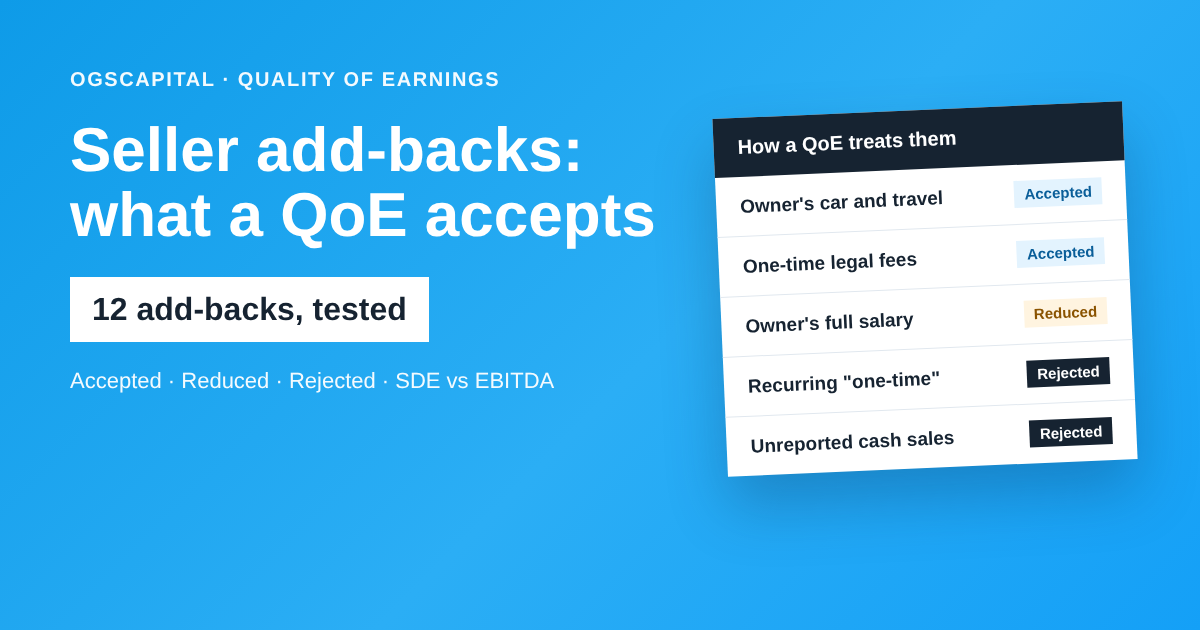
Twelve add-backs we see on most small business deals, with the usual outcome and the evidence that decides it.
| Add-back | Usual outcome | What the QoE needs to see |
|---|---|---|
| Owner’s personal expenses: car, phone, travel, meals | Usually accepted | Statements showing the cost and that it served the owner, not the business |
| One-time legal fees, settlements, sale-related costs | Usually accepted | Invoices, and proof the cost did not occur in prior years |
| Owner pay above a market replacement salary | Usually accepted | Payroll records; the add-back is the excess over what a manager would cost |
| Family members on payroll who do not work in the business | Usually accepted | Payroll records and confirmation of their role |
| Interest, depreciation, amortization, taxes | Usually accepted | Part of the EBITDA definition; tie to the general ledger |
| Rent paid to the owner’s company | Depends | Adjusted to market rent, up or down, based on the new lease terms |
| Large repairs called one-time | Depends | Accepted if truly non-recurring; rejected if it is deferred maintenance or capex |
| Owner’s full salary added back | Depends | For EBITDA, only the excess over a replacement manager’s pay; for SDE, one owner’s pay |
| A “one-time” cost that appears every year | Usually rejected | Recurring costs stay in earnings, whatever they are called |
| Unreported cash revenue | Usually rejected | Not accepted: if it is not in the tax returns and bank deposits, it is not in earnings |
| Costs the buyer would have to cut: staff, marketing, software | Usually rejected | Pro forma savings are the buyer’s upside, not the seller’s earnings |
| New contracts or price increases not yet earned | Usually rejected | Projections are not historical earnings |
Example: from the seller’s EBITDA to the QoE number
An illustrative $1M EBITDA business. The seller’s listing shows the left column; the QoE tests each line.
About 19% lower. At 4x, the $200,000 difference in EBITDA is $800,000 off the price. Two add-backs were rejected, one reduced and one negative adjustment added.
SDE vs adjusted EBITDA: how owner pay is treated
Seller’s discretionary earnings (SDE)
Adds back one owner’s full pay and benefits. Used for smaller businesses where the buyer will run the company and replace the owner. Common in broker listings.
Adjusted EBITDA
Adds back only the owner pay above what a hired manager would cost. Used for larger businesses, by lenders sizing a loan and by most QoE reports. The gap between the two is often the largest single difference in a deal.
Check which one the listing uses before comparing multiples. A 3x SDE and a 4x EBITDA can describe the same price.
What to ask, and what to prepare
Buyers: ask the seller for
- An add-back schedule by year, with one line per item
- Invoices or statements behind every add-back
- The same expense lines for the two prior years
- Payroll records for the owner and family members
- The lease and current market rent for the premises
Sellers: before you list
- Stop running personal costs through the business a year before the sale
- Keep the documents for every add-back you plan to claim
- Drop add-backs you cannot support; they cost credibility
- Put related-party rent on market terms
- Consider a sell-side QoE to test the numbers first
Test the add-backs before you sign
Every OGScapital QoE tests each add-back against invoices, bank statements and prior years, and adds the adjustments the seller left out. Sellers can do the same before going to market with a sell-side QoE. Details: quality of earnings reports.
Focused buy-side QoE in about 2 weeks. Sell-side and full-scope QoE from $10,000.
TEST MY ADD-BACKSHave an add-back schedule in front of you?
Tell us about the deal. We will send a scope to test it, with one fixed price and a delivery date.
Prefer to talk? +1-619-727-5304
FAQ
What are seller add-backs?
Add-backs are expenses a seller adds back to profit to show what the business would earn under a new owner: personal expenses run through the business, one-time costs and owner pay above market. They raise adjusted EBITDA or SDE, and with it the price.
Which add-backs does a quality of earnings report accept?
Documented add-backs that will not continue under a new owner: the owner’s personal expenses, one-time legal or sale costs, owner pay above a market replacement salary and family members on payroll who do not work in the business.
Which add-backs are usually rejected?
“One-time” costs that recur every year, unreported cash revenue, cuts the buyer would have to make, deferred maintenance and new revenue that has not been earned yet.
How much do add-backs usually change in a QoE?
In OGScapital’s QoE work, adjusted EBITDA comes in about 20% below what the seller reported on average, mostly because some add-backs do not hold up or are reduced.
What is the difference between SDE and adjusted EBITDA?
SDE adds back one owner’s full pay and benefits and is used for smaller owner-run businesses. Adjusted EBITDA adds back only the owner pay above what a hired manager would cost and is used by lenders and most QoE reports.
Can a QoE adjust earnings down?
Yes. A QoE also removes one-time revenue, adds market rent when related-party rent is below market, and adds costs the seller left out, such as under-accrued bonuses or below-market owner pay.
What documents support an add-back?
Invoices, card or bank statements, payroll records and the same expense lines for prior years, showing the cost is real, served the owner or will not recur.
Should sellers remove add-backs before selling?
Yes for anything they cannot document. Unsupported add-backs are found in the buyer’s QoE and cost credibility in the negotiation. A sell-side QoE tests them before going to market.