Share:


Table of Content
Reviewed by Alex Silensky, Partner, and the OGScapital transaction advisory team (CPA, CVA) · Updated November 2026
SHORT ANSWER: QOE VS AUDIT VS DUE DILIGENCE
An audit checks the books. A QoE checks the earnings you are buying.
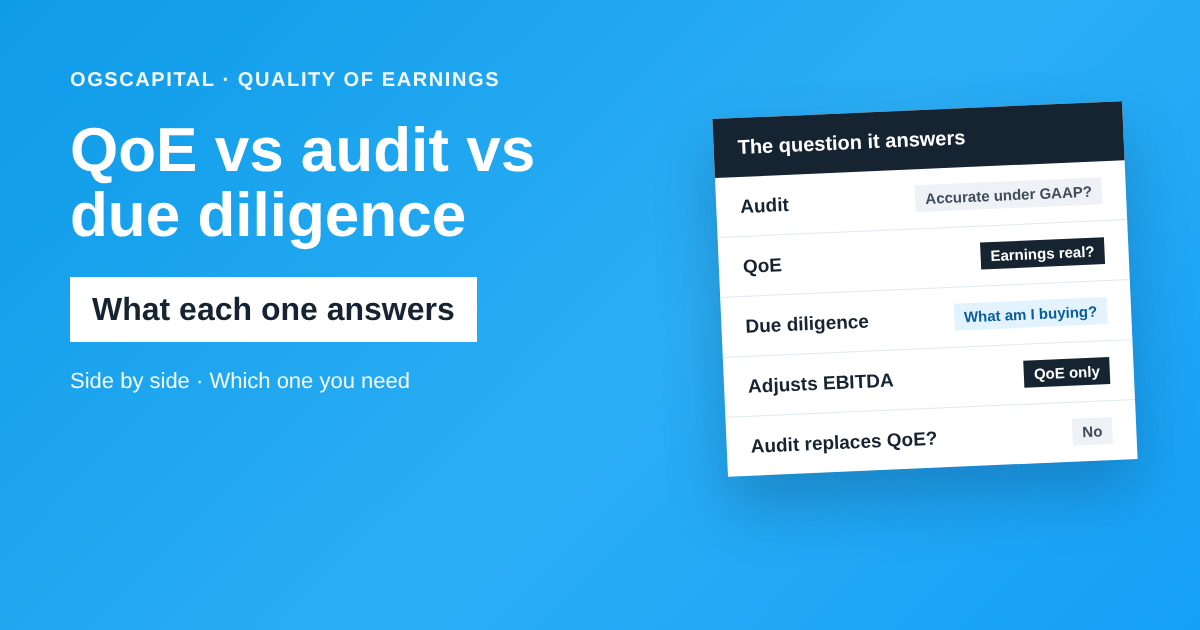
An audit gives an opinion on whether a company’s financial statements are fairly presented under accounting standards. A quality of earnings (QoE) report tests whether the EBITDA a buyer is paying for is real and will recur, and adjusts it for owner expenses, one-time items and unsupported add-backs. Financial due diligence is the wider review of a deal’s finances: it includes the QoE plus net working capital, debt-like items and other risks. When you buy a business, an audit does not replace a QoE; audited statements just make the QoE faster.
QoE vs audit vs financial due diligence, side by side
| Audit | Quality of earnings | Financial due diligence | |
|---|---|---|---|
| Question it answers | Are the financial statements fairly presented under GAAP? | Are the earnings real, recurring and correctly adjusted? | What am I buying: earnings, cash, working capital, debt and risks? |
| Who orders it | The company, often for a lender or investors | The buyer, the seller or the lender, for a deal | The buyer or its lender, for a deal |
| Who prepares it | A licensed, independent CPA firm | Transaction advisors, usually CPA-led | Transaction advisors, usually CPA-led |
| Output | A formal opinion on the statements | A report with adjusted EBITDA and every adjustment explained | A report covering the QoE and the balance sheet issues around it |
| Adjusts EBITDA for the deal | No | Yes: owner costs, one-time items, add-backs, run-rate | Yes, through the QoE |
| Working capital and debt-like items | Only as presented in the statements | In full-scope QoE | Yes: peg, net debt, deposits, accruals |
| Period | One fiscal year, after year-end | Usually two to three years plus the trailing 12 months | Same as the QoE, plus the balance sheet at closing |
| Typical timing | Weeks to months after year-end | 2–4 weeks from complete data | 3–6 weeks, depending on scope |
| Used for | Lender covenants, investors, compliance | Price, loan sizing, SBA $3M+ loans | Price, purchase agreement terms, closing adjustments |
A review engagement sits between a compilation and an audit: it gives limited assurance on the statements, at lower cost. Like an audit, it does not adjust earnings for a deal.
How a QoE fits inside due diligence
Due diligence covers the whole business. Financial due diligence is the part about the numbers, and the QoE is its core.
Adjusted EBITDA: is it real, and will it recur?
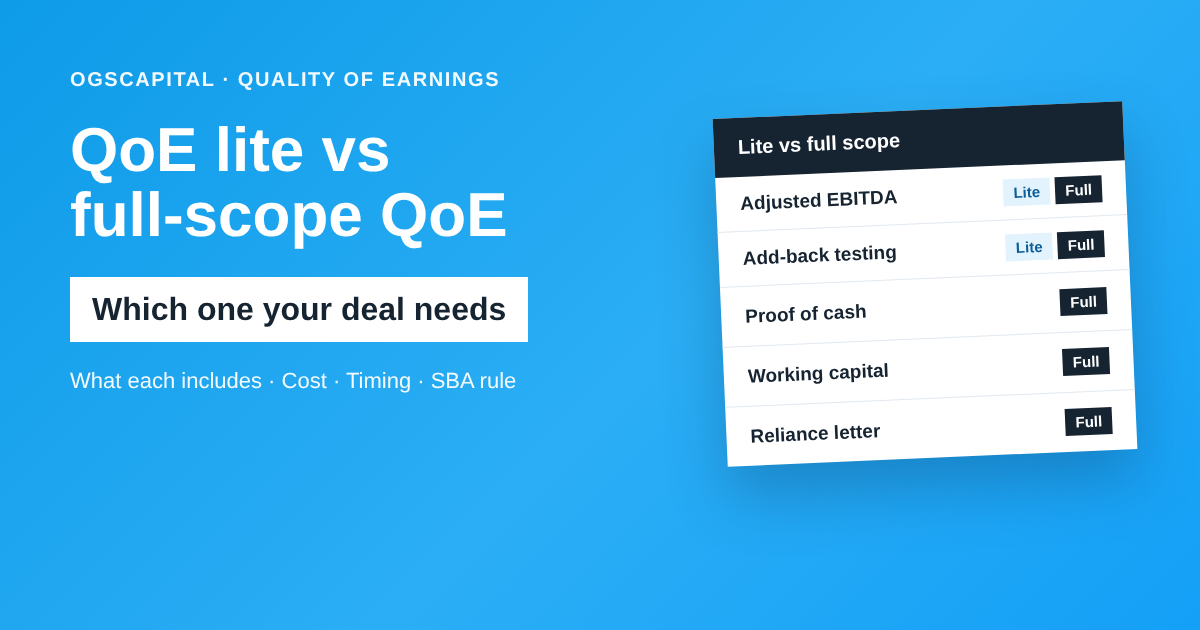
On small deals, a full-scope QoE often covers most of financial due diligence: working capital, debt-like items and proof of cash are part of it. See QoE lite vs full scope.
Does an audit replace a QoE? No. Here is what it does not cover
Audited statements are good news for a buyer: the numbers are more reliable and the QoE goes faster. But an audit answers a different question, and these issues pass an audit without a flag:
Which one do you need?
| Your situation | Order | Why |
|---|---|---|
| Buying a $1M–$15M business | QoE | Focused for cash deals; full scope if a lender relies on it. |
| SBA 7(a) loan on a $3M+ purchase | SBA-compliant QoE | Required by SOP 50 10 8.1, with the business valuation. |
| Larger deal, investors or a purchase agreement with a working capital peg | Full financial due diligence | QoE plus working capital, net debt and closing adjustments. |
| The target already has audited statements | QoE | Still needed; the audit shortens the work and can lower the fee. |
| Selling a business | Sell-side QoE | Find and fix issues before buyers and lenders do. |
| Lender covenant or investors require annual statements | Audit or review | An ongoing compliance need, not a deal decision. |
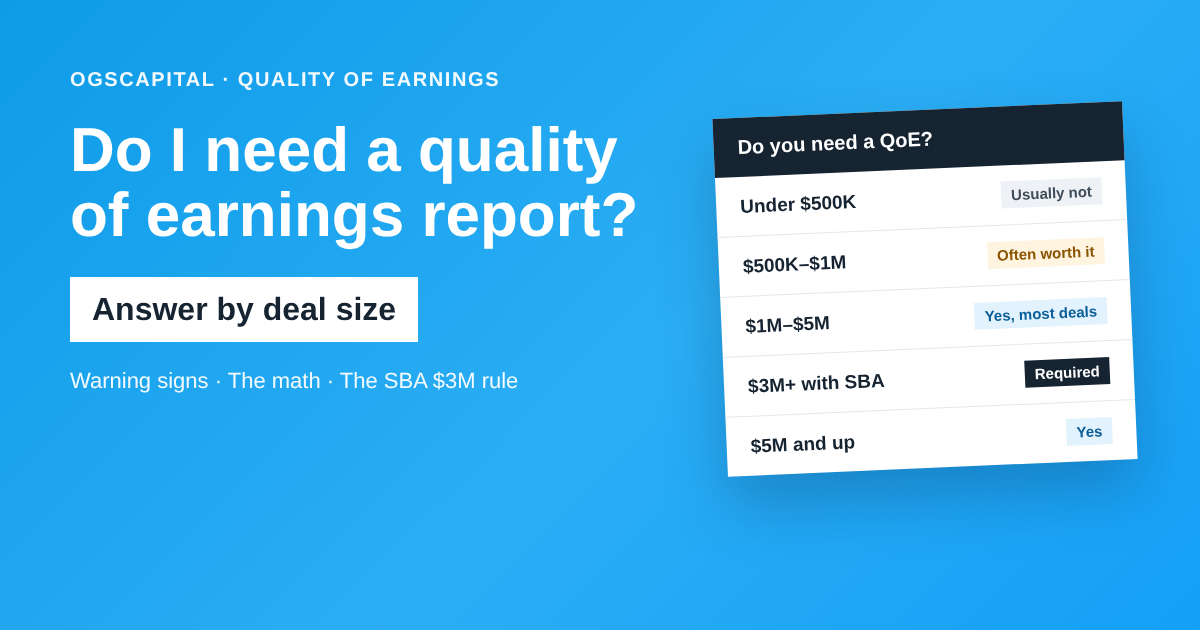
Not sure a QoE is worth it on your deal? See Do I need a QoE? Answer by deal size. Selling? See sell-side due diligence.
QoE and financial due diligence from OGScapital
We prepare about 100 QoE reports a year, mostly on $1M–$15M acquisitions, for buyers, sellers and lenders. A full-scope QoE includes proof of cash, working capital and debt-like items, so on most small deals it covers the financial due diligence a buyer needs. Audited statements make our work faster and can lower the fee. Details: quality of earnings reports.
Focused buy-side QoE in about 2 weeks. Full-scope QoE from $10,000; SBA-compliant QoE from $9,500.
ASK WHAT MY DEAL NEEDSAudit, QoE or full due diligence?
Tell us about the deal. We will say what it needs and send one fixed price and a delivery date.
Prefer to talk? +1-619-727-5304
FAQ
What is the difference between a QoE and an audit?
An audit gives an opinion on whether financial statements are fairly presented under accounting standards. A QoE tests whether the earnings a buyer is paying for are real and recurring, and adjusts EBITDA for owner expenses, one-time items and unsupported add-backs. An audit does not adjust earnings for a deal.
Is a quality of earnings report the same as due diligence?
No. A QoE is the core of financial due diligence. Financial due diligence also covers net working capital, net debt and debt-like items, and due diligence as a whole adds legal, tax, operational and other reviews.
If the business has audited financial statements, do I still need a QoE?
Usually yes. The audit confirms the statements follow the rules; it does not test the seller’s add-backs, remove one-time revenue or normalize owner costs. Audited statements make the QoE faster and can lower its cost.
Is a QoE cheaper than an audit?
For a small business acquisition, often yes: a focused QoE costs about $5,000–$15,000 and takes 1–2 weeks. Audit fees depend on the company’s size and complexity, and an audit usually takes longer.
Does a QoE give an opinion like an audit?
No. A QoE is not an assurance engagement and does not give an audit opinion. It reports the procedures performed, the adjustments and the resulting adjusted EBITDA.
What does financial due diligence include beyond a QoE?
Net working capital and a proposed peg, net debt and debt-like items such as customer deposits and accrued liabilities, proof of cash, customer concentration and the items that affect the closing statement.
Who should order the QoE, the buyer or the seller?
Both can. Buyers order a buy-side QoE to confirm the price; sellers order a sell-side QoE before going to market. For SBA loans on $3M+ purchases, the report must be prepared for the lender’s benefit.
What is a review engagement?
A review gives limited assurance that financial statements are free of material misstatement. It costs less than an audit, but like an audit it does not adjust earnings for a transaction.
Do I need an audit to buy a small business?
Rarely. Most small business acquisitions rely on a QoE, not an audit. An audit becomes relevant when a lender or investors require audited statements on an ongoing basis.