Share:


Table of Content
Why One Pitch Deck Doesn’t Work for Both Angel and VC Investors
Founders often send the same deck to everyone. They tweak a slide or two, maybe change the intro, and call it a day. Then angels say, “Interesting, let me think”, and VCs go quiet.
That usually isn’t about the idea. It’s about fit.
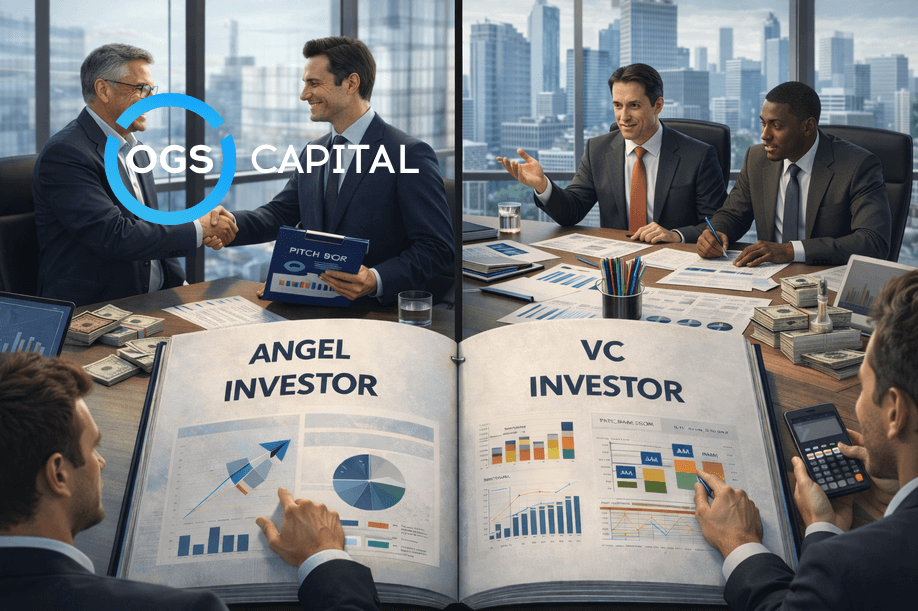
A fundraising pitch deck has to match the type of risk the investor is taking. Angels and VCs take different risks, so they look for different proof.
Angels are often backing people first. They want to understand the founder, the problem, and early momentum. They’re asking, “Do I believe this team can figure it out?”
A venture capital pitch deck is evaluated as an investment case. VCs are underwriting scale and return potential. They’re asking, “Can this become a large business with repeatable growth and a real exit path?”
So your pitch deck for angels can lean more on founder-market fit and early validation. Your VC version needs tighter market logic, clearer growth mechanics, and stronger financial narrative.
One deck can be adapted for both. But one structure rarely works for both.
Angel Investor Pitch Deck: What Early-Stage Backers Actually Look For
What Matters Most to Angel Investors
A strong angel investor pitch deck doesn’t try to look like a Series A deck. Angels know you’re early. They don’t expect polished scaling metrics. They do expect clear thinking.
Most angels focus on:
- founder–market fit: why you’re the right team for this problem
- problem clarity: a pain that feels real and specific
- early traction, even if small: signals that real customers care
- speed and learning: proof you’re moving and improving
Many founders overload angel decks with spreadsheets to look “serious”. That can backfire. It shifts attention away from the core bet: team + problem + early momentum.
You still need numbers, but keep them simple. The goal is to show that the business can work, not to prove every forecast.
If an angel can’t quickly understand what you do and why you can win, you lose the meeting.
What to Include in an Angel Pitch Deck
An angel deck should be short and decision-focused. The best pitch deck for angels follows a clean flow:
- Problem / Solution
- Market opportunity (high-level, credible)
- Product (what it does, why it’s different)
- Traction / validation (revenue, pilots, LOIs, usage, pipeline)
- Team (why you)
- Simple financial outlook (drivers, not detail)
- Ask (amount, use of funds, milestones)
This structure works because it supports how angels decide. They want to see a clear bet and a clear plan for the next milestone.
Keep the tone grounded. Don’t overpromise. Show what you know, what you don’t know yet, and how you’re going to learn fast.
A good angel fundraising pitch deck makes it easy for someone to say, “I get it. I want to help”.
VC Pitch Deck Requirements: What Venture Capital Firms Expect to See
How VC Evaluation Differs From Angels
VCs evaluate deals as part of a portfolio. They’re not just asking whether your startup can work. They’re asking whether it can become a venture-scale outcome.
That’s why vc pitch deck requirements are stricter. A VC wants to see:
- a market large enough to support outsized returns
- scalability, not just product-market fit
- early unit economics logic
- a repeatable go-to-market motion
- valuation logic that fits the stage and the story
If you show up with an angel-style narrative, you often fail the first screen. Not because it’s “bad”, but because it doesn’t answer the questions VCs must answer internally.
A venture capital pitch deck has to feel like an investment memo. Clear thesis. Clear risks. Clear path to scale.
What Must Be Inside a VC Pitch Deck
A VC deck still needs a strong story. But it has to be structured around proof and scalability.
At minimum, a venture capital pitch deck should include:
- TAM/SAM/SOM with credible assumptions
- growth mechanics: what drives pipeline, conversion, and expansion
- CAC/LTV logic and payback direction
- competitive positioning that holds at scale
- financial projections tied to real drivers
- exit landscape: how this becomes a large outcome
These aren’t “extra slides.” They are the core of VC decision-making.
If your deck can’t explain how growth becomes repeatable, investors assume it’s not repeatable. And if the financial story doesn’t connect to the go-to-market plan, they assume the plan isn’t real.
That’s what VCs mean when they say, “We didn’t get conviction”.
Key Differences Between Angel and VC Pitch Decks
Many founders understand that angels and VCs are different. Fewer understand how that difference should shape the deck.
An angel investor pitch deck is built around belief. A venture capital pitch deck is built around scale.
Here’s the practical difference:
| Area | Angels | VCs |
|---|---|---|
| Focus | Team, vision, early momentum | Market size, growth, returns |
| Traction level | Early signals are enough | Repeatable traction is expected |
| Financial depth | Light, directional | Structured and model-driven |
| Storytelling vs metrics | Story first | Metrics first |
| Risk profile | Personal conviction | Portfolio math |
A pitch deck for angels leans into founder-market fit and early validation.
A deck built to meet vc pitch deck requirements prioritizes scalability, unit economics logic, and exit potential.
Founders often fail because they present a founder-driven story to VCs or a metric-heavy case to angels.
Neither is wrong. Both are misaligned.
Once you see this clearly, adapting your deck becomes much easier.
Common Mistakes Founders Make When Preparing Fundraising Pitch Decks
Most fundraising problems don’t come from bad ideas. They come from avoidable deck mistakes.
These show up again and again in both angel rounds and venture capital pitch decks:
- using one fundraising pitch deck for every investor
- weak or vague market logic
- optimistic numbers with no real drivers
- no clear ask or milestone plan
- mismatch between story and metrics
Founders often hear, “Looks good,” and then nothing happens.
That usually means investors couldn’t connect the narrative to execution.
In a venture capital pitch deck, this shows up as growth claims without scalable mechanics.
In early rounds, it looks like enthusiasm without enough structure.
Another common issue is treating financials as decoration. Slides show big revenue curves, but no explanation of how those curves happen.
Investors don’t reject decks because forecasts are imperfect. They pass because the logic isn’t clear.
Fixing these mistakes early saves months of stalled fundraising.
How to Adapt One Core Pitch Deck for Angels and VCs
You don’t need two completely separate decks. You need one strong core and two focused versions.
Start with a master fundraising pitch deck that contains everything: full story, metrics, assumptions, and financial logic.
Then adapt.
For angels:
- simplify financials
- emphasize founder story and problem clarity
- highlight early traction and learning speed
This becomes your pitch deck for angels.
For VCs:
- deepen metrics
- clarify go-to-market mechanics
- show scalability proof
- align projections with execution plans
This version meets vc pitch deck requirements.
Same business. Same vision. Different emphasis.
This approach keeps your message consistent while respecting how each investor evaluates risk.
Founders who do this well move faster. They get clearer feedback. And they avoid rebuilding their deck from scratch every time the audience changes.
When to Get Professional Pitch Deck Support
Founders often wait too long to get help. They polish slides. They tweak numbers. They resend the deck. And the result stays the same.
If you need an outside perspective, a pitch deck consultant can quickly spot where the story, structure, and financial logic break investor expectations.
Investors say, “Interesting”, but don’t follow up.
That’s usually not a network problem. And it’s rarely about design. It’s a structural issue.
At that point, a fundraising pitch deck needs an outside review. Someone has to look at it the way investors do. Does the story match the numbers? Do the assumptions support the valuation? Is the deck answering the right questions for the stage?
This is where professional support makes sense.
At OGScapital, pitch deck reviews focus on structure, financial logic, and positioning. The goal isn’t to “make it prettier”. The goal is to align the deck with real venture capital pitch deck expectations and fix the gaps that block conviction.
If outreach stalls, that’s the signal. Fix the structure before you pitch again.
Angel vs VC Pitch Deck Strategy: Build for the Capital You’re Raising
An angel investor pitch deck and a VC deck are not variations of the same story. They are answers to different questions.
Angels fund belief.
VCs fund scale.
Angels want to know why you’re the right team and why the problem matters now. VCs want to know whether the business can grow fast, repeatably, and at a size that justifies the risk.
Your fundraising pitch deck should always reflect the type of capital you’re raising. That means adjusting focus, depth, and proof – not rewriting the entire story every time.
When founders build decks with this distinction in mind, investor conversations get clearer. Feedback gets sharper. And fundraising moves faster.
Build for the investor you’re pitching. Not the one you pitched last.
Frequently Asked Questions
What’s the main difference between an angel investor pitch deck and a VC pitch deck?
An angel investor pitch deck focuses on the team, the problem, and early momentum. A VC pitch deck focuses on scalability, market size, and return potential. The difference reflects how each investor evaluates risk.
Can I use the same fundraising pitch deck for angels and VCs?
You can use the same core story, but not the same structure. Angels and VCs look for different proof. Most founders need two tailored versions built from one master fundraising pitch deck.
What are the most common VC pitch deck requirements?
VCs expect clear market sizing, scalable growth mechanics, unit economics logic, financial projections tied to execution, and a credible exit narrative.
Why do investors say “interesting” but never follow up?
That usually means the pitch deck lacks clarity or alignment. The story, numbers, or positioning don’t fully support an investment decision.
When should founders get professional pitch deck help?
If outreach stalls or feedback stays vague, it’s time. Professional review helps align the fundraising pitch deck with investor expectations before the next round of meetings.
Preparing a Pitch Deck for Angels or VCs?
If investors say “interesting” but don’t follow up, the problem is usually not your idea – it’s how your pitch deck presents it.
Most decks fail because the story, numbers, and positioning aren’t aligned with real investor expectations.
At OGScapital, we help founders turn decks into clear fundraising tools.
Our pitch deck consulting services focus on structure, financial logic, and investor readiness – not visual polish.
Whether you’re pitching angel investors or preparing for venture capital meetings, we help you build a deck that supports real funding decisions.
Start with a professional pitch deck review and fix the gaps before your next outreach.
No design fluff. Clear structure. Honest investor-level feedback.