Share:


Table of Content
The real reason projects fail: decisions made on untested assumptions
Most projects don’t fail because people don’t work hard. They fail because the decision was wrong at the start.
It usually looks like this.
A team falls in love with an idea. Or a location. Or a “proven” concept they saw in another city. They run quick numbers. They ask a few friends. They pull a couple of industry reports. Then they move forward fast because the deal window is closing.
And later the real world shows up.
- Demand isn’t as strong as expected.
- Pricing is lower than planned.
- Costs are higher.
- Permits take longer.
- Hiring is harder.
- Competitors react.
- The ramp takes twice as long.
At that point, you’re no longer “deciding.” You’re managing damage.
This is why a feasibility study for decision making matters. It forces you to test the assumptions that actually drive the outcome. Not the assumptions that look good in a pitch deck.
Here are the assumptions that usually break first:
Demand assumptions.
People often use big market numbers. But they don’t validate local capture. They don’t ask who buys, why they buy, and what makes them choose one option over another.
Pricing assumptions.
The plan uses a target price. But the market chooses the price. If your price depends on being “premium,” you need proof that buyers will pay for that.
Cost assumptions.
Early budgets miss line items. Or they assume best-case vendor pricing. Or they ignore inflation and change orders. Small misses compound fast.
Timing assumptions.
A model can look great if the opening date is optimistic. Delays are common. Every month of delay is carrying costs without revenue.
Operational assumptions.
A plan can work on paper and still fail in execution because the operating model is unrealistic. Capacity, staffing, utilization, and throughput limits matter.
A proper business feasibility assessment brings those assumptions into the open. It doesn’t just “predict revenue.” It shows what must be true for the project to work and what happens if reality is slower or more expensive than planned.
That’s also why feasibility analysis before investment is often the cheapest risk-control step you can take. Once you sign a lease, buy land, or place long-lead orders, you’ve already paid for your assumptions.
A feasibility study for decision making is not about being pessimistic. It’s about being clear. It helps you choose between three outcomes:
- Go. The economics work under realistic assumptions.
- No-go. The project only works in a best-case story.
- Go, but change the plan. Different pricing, scope, location, unit mix, or timing.
If you’re making a real commitment of capital, you want that clarity early. That’s the difference between moving fast and moving blind.
What a feasibility study is (and what it is not)
People use the term “feasibility study” in a vague way. That creates confusion. Especially in the U.S., where founders and operators often jump straight to a business plan, or they treat market research as a yes/no answer.

So, what is a feasibility study?
A feasibility study is a decision document. It answers one question:
Should this project move forward under real conditions?
And if yes: under what assumptions and constraints does it still work?
That’s the feasibility study meaning in practice. It is not just “research.” It is not a narrative. And it is not a set of optimistic projections.
A good feasibility study does three things:
- Defines the decision and the boundaries.
What are we deciding? Launch or not? Which location? Which product mix? How much capacity? What price range? What timeline? - Tests the assumptions that change the outcome.
It focuses on the drivers that actually swing results: demand, pricing, costs, ramp timing, operational constraints, and risks. - Produces decision-ready outputs.
Not just “insights,” but scenarios, sensitivity testing, break-even logic, and clear conclusions.
What a feasibility study is not
A feasibility study is not a business plan. A business plan explains how you will execute. It can be a funding document. It can be a roadmap. But it often assumes the decision is already made.
A feasibility study is not only market research. Market research is useful. But market research does not automatically prove viability. A market can be large and still be wrong for your unit economics, your location, or your operating model.
A feasibility study is not a “template report.” Real feasibility work is tailored to the project. The point is to reduce uncertainty where it matters.
Typical feasibility study components
Most feasibility studies include a mix of these feasibility study components (the exact blend depends on the project):
- Market feasibility: real demand, local competitive set, pricing reality, customer drivers.
- Financial feasibility: revenue logic, cost structure, cash flow timing, downside scenarios.
- Operational feasibility: capacity, staffing, throughput, supply chain, process constraints.
- Technical feasibility (when relevant): site constraints, build requirements, tech dependencies.
- Regulatory feasibility (when relevant): permitting, licensing, zoning, compliance constraints.
Notice the pattern. These feasibility study components are not “nice-to-have.” They are there to answer the decision question with enough evidence to be defensible.
If you want a clean place to understand how feasibility fits inside the broader planning workflow, you can start from the main OGScapital site and navigate into the relevant service paths: OGScapital.
And one more point that matters: a feasibility study isn’t valuable because it’s long. It’s valuable because it forces the model to match reality. When it’s done right, you don’t “feel better.” You know what’s true, what’s assumed, and what could break.
Who a feasibility study consultant is – and what they actually do
A feasibility study consultant is not a report writer. And not just a financial modeler.
Their role is more practical than most people expect. They help you make a high-stakes decision before it becomes expensive to reverse.
Most projects don’t fail because nobody ran the numbers. They fail because the numbers were built on weak assumptions, incomplete data, or a model that ignored how the business would actually operate. A feasibility study consultant exists to catch those issues early, when changing direction is still cheap.
So, what does a feasibility study consultant do in real terms?
They take your idea, strip away the story around it, and test whether it works under realistic conditions.
Turning assumptions into testable inputs
Every project starts with assumptions. Some are reasonable. Many are not. The problem is that, in early planning, assumptions often turn into “facts” once they land in a spreadsheet.
One of the core feasibility consultant responsibilities is to separate what is known from what is assumed. Demand, pricing, costs, timing, and capacity are all questioned. Not to slow the project down, but to make the decision defensible.
This is a key part of the feasibility study consultant role. Without this step, even a clean-looking model can be misleading. On the surface, everything adds up. Under scrutiny, it doesn’t.
This is also why companies that rely on feasibility study consultants rather than internal projections tend to uncover risks earlier – not because consultants are pessimistic, but because they are not emotionally attached to the idea.
Validating demand beyond “market size”
Large market numbers are easy to find. They are also easy to misuse.
A feasibility study consultant does not ask, “Is this market growing?”
They ask, “Can this project capture enough demand, at this price, in this location, within a realistic timeframe?”
That means looking at real competitors, actual pricing, customer behavior, and local constraints. It also means being honest about how fast demand can ramp and what happens if it ramps slower than expected.
This is where many early-stage plans quietly break. And it’s one of the clearest answers to what does a feasibility study consultant do that actually changes outcomes.
Stress-testing operations, not just revenue
A project can look profitable on paper and still fail because the operating model does not work.
Consultants pressure-test the mechanics:
- staffing levels and labor costs
- capacity limits and utilization assumptions
- permitting and regulatory timelines
- fixed costs that start before revenue
- dependencies that create bottlenecks
This operational layer is often missing from early financial models. But it’s where risk concentrates.
A feasibility study consultant brings these constraints into the model so the numbers reflect how the business will actually run, not how it looks in a best-case scenario. This is especially important when the analysis needs to hold up in front of lenders or investors, where assumptions are questioned line by line.
Building financials that can survive scrutiny
Feasibility is not about showing upside. It’s about showing resilience.
A proper feasibility analysis includes downside scenarios, sensitivity testing, and break-even logic. It shows which assumptions matter most and how quickly the project deteriorates if they move in the wrong direction.
In practice, this is often the point where teams realize they need experienced feasibility study consultants – not to “sell” the project, but to make sure the analysis stands up to external review and funding requirements. This is exactly the kind of work covered in OGScapital’s feasibility study consulting practice, where feasibility is treated as a decision tool, not a formality.
What you should expect at the end
A solid feasibility engagement does not end with vague conclusions.
It produces a clear outcome:
- proceed as planned
- proceed with changes
- or stop before committing capital
That conclusion is supported by transparent assumptions, realistic scenarios, and a model that reflects operational reality. Even when the answer is “no,” the value is clarity. Knowing why a project does not work is often more useful than moving forward blindly.
That is the real function of a feasibility study consultant. Not to convince you that an idea is good, but to help you decide whether it makes sense to move forward – and under what conditions it actually works.
FAQ: Key questions about feasibility studies and consultants
Do you really need a feasibility study if you already have a business plan?
Yes. A business plan explains how you plan to execute. A feasibility study tests whether the plan works under realistic conditions. Many projects fail not because execution was poor, but because the decision to proceed was never properly validated.
What does a feasibility study consultant do that internal teams usually miss?
They challenge assumptions. Internal teams are often emotionally invested in the idea and tend to model best-case scenarios. A feasibility study consultant focuses on demand realism, cost completeness, timing risks, and downside scenarios to make the decision defensible.
Is a feasibility study about proving that a project will work?
No. A feasibility study is about understanding whether a project works, why it works, and under what conditions it stops working. In many cases, the most valuable outcome is discovering early that the project is not viable in its current form.
When you need a feasibility study (timing rules)
Most teams ask for a feasibility study when the deal is already in motion. That’s late.
If you wait until after you sign a lease, buy land, or lock a vendor contract, your options shrink fast. At that point, the goal becomes “make it work,” not “make the right decision.”
So, when do you need a feasibility study?
You need it before the first irreversible commitment. Not before you “feel ready.” Before you’re stuck.
Here are the most common timing triggers in the U.S. market.

The “you should already be doing it” moments
1) Before you commit to a location
This is especially true for real estate-driven models (retail, hospitality, self-storage, clinics, restaurants). A strong concept can still fail in the wrong trade area. If location is part of the thesis, you need feasibility before the lease or purchase. That’s feasibility analysis before investment in its simplest form: don’t buy the wrong box.
2) Before you commit serious capex
Construction, equipment, tenant improvements, long-lead orders. Once you spend that money, your flexibility is gone. A feasibility study can show whether your unit economics still hold when costs increase, timelines slip, or demand ramps slower.
3) Before you scale
Scaling multiplies mistakes. If your first unit is “kind of working,” that is not a green light. It’s a warning to validate what’s actually driving performance. When do you need a feasibility study for scaling? When expansion capital is on the table, and you need to know whether results are repeatable.
4) Before you raise capital or take on debt
Investors and lenders will ask similar questions, even if they use different language. They want to see downside logic, assumptions, and a defensible case that survives scrutiny. A feasibility study before funding helps you avoid building a pitch on fragile inputs.
5) When the plan has multiple moving parts
New market, new product line, new pricing model, new operations, new partner. Complexity increases risk. The more unknowns you stack, the more you need a feasibility study for decision making.
A simple timing checklist
| If you are about to… | Do feasibility now because… |
|---|---|
| Sign a lease or buy a site | Location risk is hard to reverse |
| Order equipment or start build-out | Capex becomes sunk cost fast |
| Hire ahead of revenue | Burn rate rises before demand is proven |
| Pitch investors or approach banks | Assumptions will be challenged anyway |
| Launch in a new city/state | Demand and competition don’t transfer cleanly |
If you’re still unsure, use this rule: when do you need a feasibility study? When you’re choosing between paths that will cost real money to undo.
And if you already made a commitment, feasibility can still help. But the goal changes. It becomes “minimize risk and redesign the plan,” not “go/no-go.”
Types of feasibility: what each one checks (and what it protects you from)
A feasibility study is not one thing. It’s a set of tests.
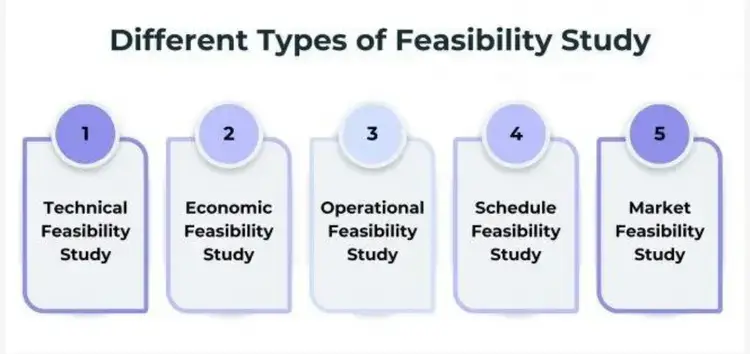
The mistake I see often is buying the wrong scope. Teams pay for a generic report, then learn too late that the real risk was somewhere else. Usually operations, pricing, or timing.
Below are the main types, what they answer, and when they matter most.
Market feasibility (demand and competition)
A market feasibility analysis answers:
- Who buys, and why?
- What are the real alternatives?
- What do competitors charge, and how do they position?
- What share can you realistically capture, and how fast?
This matters when demand is uncertain or location is part of the business case. It’s also where “market size” gets corrected into “local capture.”
Financial feasibility (unit economics and cash reality)
A financial feasibility study answers:
- Do the economics work under realistic assumptions?
- What happens under a slower ramp or higher costs?
- When does the project break even?
- How much cash is needed before stability?
This is where feasibility becomes decision-grade. It turns the concept into scenarios. It shows whether the plan survives pressure.
Technical feasibility (can it be built or implemented)
A technical feasibility assessment answers:
- Can the project be built or delivered with available technology and constraints?
- Are there site, engineering, systems, or integration risks?
- Are there dependencies that can delay launch or raise costs?
This matters in construction-heavy projects and tech-enabled models where implementation risk is real.
Operational feasibility (can the business actually run)
An operational feasibility analysis answers:
- Can you staff it at realistic wages?
- Can the process deliver the promised throughput?
- Are capacity and utilization assumptions realistic?
- Where are the bottlenecks?
This is a common failure point. A plan can look profitable and still be operationally impossible.
Regulatory feasibility (permissions and compliance constraints)
Regulatory feasibility answers:
- What approvals, licenses, zoning, and compliance requirements apply?
- What is the real timeline and risk of delay?
- Are there constraints that change the operating model?
This matters in healthcare, alcohol-related concepts, childcare, construction, and many location-dependent businesses.
If you want to think about scope correctly, don’t start with “what’s included in a feasibility study.” Start with: what could kill the project? Then build the feasibility study around that risk.
Feasibility study vs business plan vs market research (clean comparison)
People mix these up. And the wrong choice costs money.
Here’s the cleanest way to separate them:
- Market research describes what’s happening in the market.
- A business plan explains how you will execute.
- A feasibility study tests whether the project works under real conditions.
That’s why the feasibility study vs business plan question matters. They serve different decisions.
Market research: insight, not a go/no-go decision
Market research helps you understand demand, segments, and competitors. It can be strong. It can also be misleading if you try to treat it as proof of viability.
This is why feasibility study vs market research is not a technical debate. It’s a decision problem. Market research might tell you demand exists. It won’t tell you if your unit economics work, with your costs, in your location, on your timeline.
Business plan: execution narrative and operating roadmap
A business plan is often used to communicate strategy and execution. It explains the “how.” It can include financials, but those financials are only as good as the assumptions behind them.
If you’re past the go/no-go stage and you need a funding-ready execution package, that’s where business plan writing services fit naturally. The plan helps you present the strategy once the viability is clear.
Feasibility study: decision validation under pressure
A feasibility study is built for one job: make the decision defensible.
It stress-tests assumptions. It forces downside scenarios. It shows break-even logic. It tells you what must be true for the project to work, and what happens when reality moves against you.
That’s why feasibility study vs business plan is often the difference between “a convincing story” and “a decision you can stand behind.”
Where “business case” fits
A business case is usually an internal justification: why the project is worth doing. It can be qualitative and strategic. But it still needs feasibility to confirm that the economics and constraints support the case.
That’s the practical answer to feasibility study vs business case: one argues the rationale, the other tests the viability.
A simple ordering that works
In many U.S. projects, the clean sequence is:
- Market research (if demand is unclear)
- Feasibility analysis before investment (to validate the decision)
- Business plan (to package execution and funding)
And if you’re at the point where you need the feasibility work built to hold up under lender or investor scrutiny, it’s usually time to hire a feasibility study consultant rather than relying on internal best-case projections.
Key Questions About Timing, Scope, and Choosing the Right Feasibility Approach
Is it ever too early to run a feasibility study?
No. A feasibility study is most valuable before you make irreversible commitments like signing a lease, purchasing land, or investing major capital. Running it early preserves flexibility and prevents costly mistakes.
Do all projects need every type of feasibility analysis?
No. Feasibility scope should be driven by risk. Some projects fail due to weak demand, others due to operations, timing, or regulatory constraints. The right feasibility study focuses on what could realistically break the project.
When should feasibility come before a business plan?
Feasibility should come first when the go/no-go decision is still open. It validates whether the economics work. The business plan comes after, once execution and funding need to be clearly documented.
Can market research replace a feasibility study?
No. Market research explains demand and competition, but it does not test unit economics, operating constraints, or downside scenarios. Feasibility connects market insights to financial and operational reality.
What “good” looks like: deliverables and what lenders/investors want to see
Most people can’t tell the difference between a real feasibility study and a polished narrative. That’s a problem, because lenders and investors will.
A serious feasibility study is built to be questioned. It holds up when someone asks, “Where did this number come from?” and “What happens if reality is worse than your base case?”
Here’s what “good” looks like in practice.
The core feasibility study deliverables (and why they matter)
A strong study usually includes the same backbone, even if the industry changes. These feasibility study deliverables are what make the work usable for real decisions, not just for internal alignment.
| Deliverable | What it does for the decision |
|---|---|
| Assumptions log | Separates facts from estimates and flags what needs validation |
| Market and competitive logic tied to numbers | Connects demand and pricing to revenue, not just “market size” |
| Operating model | Shows how the business actually runs (capacity, staffing, ramp constraints) |
| Financial model with scenarios | Tests viability under realistic and conservative conditions |
| Sensitivity testing | Shows what variables can break the project |
| Risks + mitigation options | Turns unknowns into action items |
| Clear conclusion | Go / no-go / go with changes, with evidence |
A lender ready feasibility study is basically this same structure, but with extra discipline. Assumptions must be traceable. Downside scenarios must be clear. And the model needs to show cash timing, not just profitability.
That’s also where feasibility study assumptions become the main battlefield. The numbers themselves are less important than the logic behind them. If the feasibility study assumptions are soft, the whole study becomes soft.
What lenders and investors usually challenge first
They typically don’t start by arguing with your mission. They start by pressuring the drivers.
- Demand realism: not “is there a market,” but “what share is realistic, and how fast?”
- Pricing: what proves customers will pay that price in that location?
- Costs: what’s missing, what’s undercounted, what moves with inflation?
- Timing: what happens if opening is delayed by 60–120 days?
- Operations: can the model actually deliver the throughput you’re assuming?
This is why sensitivity analysis feasibility study work is not optional if you want credibility. A good sensitivity analysis feasibility study doesn’t just show “best/base/worst.” It shows what variables matter most and how quickly the project turns from viable to fragile.
A lender ready feasibility study also needs to be readable. Not “short,” but clear. People underwriting risk want to see the logic fast.
If you’re building this for external review, the simplest way to think about it is this: the feasibility study deliverables should make it easy for a third party to say, “I understand the assumptions, I understand the downside, and I see why the conclusion makes sense.”
And if you need an investor-ready package that’s designed to survive that level of scrutiny, it usually helps to start from an investor-ready feasibility study framework rather than trying to retrofit a basic model later.
Use cases by industry: who needs a feasibility study and why
Feasibility work isn’t only for “big” projects. It’s for any decision where the downside is expensive.
If you’re reading this and thinking, “Is this for my case?” – these are the most common scenarios.
Startups and new ventures
A feasibility study for startups is usually about one thing: reality-checking traction and unit economics before you burn through runway.
Founders often have a clear product vision but unclear demand proof at a price that supports margins. A feasibility study for startups connects market reality to a workable model: pricing, customer acquisition assumptions, ramp, churn risk (when relevant), and cash timing.
If you want a deeper breakdown tailored specifically to early-stage companies, this feasibility study for startups guide is a useful companion.
Real estate and location-driven businesses
A feasibility study for real estate development is different from a generic market report. The risk is local and specific. Demand can be strong in a metro area and still be wrong in a trade area.
A feasibility study for real estate development typically focuses on site-level demand, competing supply, realistic absorption or utilization, achievable pricing, and how timing affects cash flow.
Hospitality (especially hotels)
A feasibility study for hotel project decisions often comes down to a few drivers: local demand segments, seasonality, competitive set positioning, ADR assumptions, occupancy ramp, and operational cost reality.
Hotels are highly sensitive to timing and market cycles, which is exactly why feasibility needs scenarios, not just a single projection.
Self-storage
A feasibility study for self storage is usually about supply and absorption. Many self-storage markets swing quickly once new facilities open nearby.
Here, feasibility has to be honest about competitor pipeline, lease-up curves, pricing pressure, and what happens if stabilization takes longer than planned.
Expansion and new locations
Expansion failures are often “success bias.” Teams assume a winning model will win everywhere.
Expansion feasibility analysis is what forces the uncomfortable questions: does demand transfer, does pricing hold, do labor conditions change, do permits slow you down, does competition look different, and can your operations scale without breaking?
If your decision is “open location #2 or #10,” expansion feasibility analysis is the difference between repeatable growth and amplified mistakes.
Risk reduction: the hidden value of feasibility (why it saves money)
A feasibility study is easy to frame as a cost. That’s normal. It’s also the wrong frame.
Feasibility is a risk tool. It reduces the chance that you commit to a decision you can’t unwind.
Most expensive problems show up after commitment:
- you sign the lease and learn the ramp will be slower
- you start build-out and discover missing costs
- you hire ahead of revenue and burn cash faster than planned
- you take on debt and find coverage is tight under downside conditions
This is where business risk assessment feasibility matters. It turns vague risk into specific risk: which assumptions can break the project, how likely they are, and how much they cost if they go wrong.
A proper feasibility study risk analysis does not try to predict the future perfectly. It makes sure the plan is resilient to the most common ways reality deviates from the spreadsheet.
Here’s the practical value:
It prevents “quiet failure.”
Quiet failure is when the project doesn’t collapse fast. It just underperforms for long enough to drain capital. A good feasibility study risk analysis shows you whether that slow bleed is likely and what triggers it.
It forces conservative decision logic.
If the plan only works in a best case, that should be obvious. Business risk assessment feasibility makes “best case” visible for what it is: a gamble.
It makes changes cheaper.
Discovering a flaw before commitment is cheap. Discovering it after commitment is expensive.
And yes, sometimes feasibility tells you to stop. That is not wasted money. It’s often the highest ROI outcome, because it explains why businesses fail without feasibility study work in the first place: people commit to assumptions, not to validated reality.
If you want to summarize feasibility in one line, it’s this: you’re not paying for a document. You’re paying to reduce the cost of being wrong.
Key Questions About Feasibility Deliverables, Use Cases, and Risk Reduction
What makes a feasibility study “lender-ready” or “investor-ready”?
Clear assumptions, realistic downside scenarios, and transparent financial logic. Lenders and investors focus less on upside and more on whether the project holds up when demand, pricing, or timing fall short.
Is a feasibility study only relevant for large or complex projects?
No. Feasibility is most valuable whenever the downside is expensive. Startups, expansions, and location-driven businesses often benefit more than large corporations because early mistakes have a bigger impact.
How does a feasibility study actually reduce business risk?
It identifies which assumptions can break the project, tests how sensitive results are to those assumptions, and shows whether the business remains viable under conservative conditions.
What is the most common mistake in feasibility studies?
Treating feasibility as a formality instead of a decision tool. When assumptions are optimistic or unexplained, the study may look polished but fail to prevent costly mistakes.
Cost of a feasibility study: what drives pricing (and what you’re really paying for)
People usually ask one question first: how much does a feasibility study cost?
There isn’t one number that’s honest. Feasibility study pricing depends on scope, data quality, and how defensible the work needs to be. A quick internal sanity check costs less than a lender-ready package that can survive due diligence.
If you want a clean way to think about it, start with the feasibility study cost factors that actually move price.
| Cost driver | What it changes |
|---|---|
| Project complexity | More moving parts means more assumptions to test and more scenarios to model |
| Data availability and quality | Missing or messy data increases time and risk, so analysis takes longer |
| Depth of market validation | Local competitor mapping and pricing validation is more work than generic research |
| Modeling requirements | Scenarios and sensitivity testing add real effort but also real decision value |
| Timeline | Rush work usually costs more because it compresses the workflow |
| Stakeholder requirements | Lenders and investors expect tighter logic and clearer support |
Those are the real feasibility study cost factors. Not “industry” by itself.
So, how much does a feasibility study cost in practical terms? It scales with the consequences of being wrong. If you’re making a small bet, you can justify a lighter scope. If you’re committing capital, debt, or signing a long-term lease, you want the work to be rigorous.
This is also why people ask, is a feasibility study worth it? The better question is: what’s the cost of a wrong decision without it? If feasibility prevents one bad location, one overbuilt scope, or one unrealistic ramp assumption, it usually pays for itself.
And if your feasibility work is tied to investors or lenders, you’re not just buying analysis. You’re buying clarity that holds up in underwriting. That’s the point of a feasibility study for funding decisions – the study is built to survive scrutiny, not just to look good internally.
One more time, because it’s the common objection: is a feasibility study worth it? If you’re making irreversible commitments, it’s often one of the highest ROI steps you can take before you lock the deal.
How to choose a feasibility study consultant (checklist + red flags)
Most people don’t regret doing a feasibility study. They regret paying for one that doesn’t help them make a decision.
So, how to choose a feasibility study consultant comes down to one thing: can they produce decision-grade work, not a generic report?
Here’s a practical checklist.
What to look for (the stuff that actually matters)
1) Clear assumptions and traceable logic
Ask to see how they document assumptions. If assumptions are hidden, the study is weak. Decision work must be auditable.
2) Real market validation, not “report screenshots”
A serious consultant ties market and competitor logic directly to pricing and demand assumptions. They don’t rely on generic market-size charts.
3) Scenario and downside discipline
If the model has only one “base case,” that’s not feasibility. You want downside scenarios, break-even logic, and sensitivity testing.
4) Operational realism
Many studies fail because they ignore operational constraints. Staffing, capacity, ramp timing, and fixed-cost timing matter.
This is what hiring a feasibility consultant should get you: a plan that survives pressure, not a document that confirms your hopes.
Qualifications that signal credibility
There isn’t one credential that guarantees quality, but feasibility study consultant qualifications should show real exposure to decision-making under constraints: projects with capital commitments, debt, stakeholder scrutiny, and time pressure. Ask what types of projects they’ve tested and what deliverables they produce.
The red flags to watch for
If you want the fastest filter, watch for feasibility study red flags like these:
- conclusions that don’t match the numbers
- assumptions that are not stated clearly
- no downside scenarios or sensitivity testing
- generic market data with no local validation
- a model that doesn’t reflect operational limits
Those are feasibility study red flags because they tell you the study won’t protect you when reality deviates from the spreadsheet.
And yes, how to choose a feasibility study consultant is also about fit. If you need the work to support lenders or investors, the standard is higher. In that case, you want a consultant who can stand behind the assumptions and explain them clearly under questioning.
If you’re at that stage, it usually makes sense to request a feasibility study consultation so scope, inputs, and expectations are aligned before any work starts.
If you want a longer, step-by-step guide, this is also covered here: How to choose a feasibility study consultant.
Feasibility vs due diligence vs valuation (when each tool is the right one)
People often mix these up because they all involve analysis and numbers. But they answer different questions.
A feasibility study is forward-looking. It tests whether a plan works under realistic conditions. Due diligence and valuation are often deal-driven and focus on risk from different angles.
Feasibility study vs due diligence
Feasibility study vs due diligence is mainly “future plan” versus “verification and risk checks.”
- Feasibility: Should we do this, and under what conditions does it work?
- Due diligence: What risks exist in what we’re buying or financing, and what’s real vs assumed?
In many real deals, you use both. Feasibility validates the plan. Due diligence verifies the reality and risks around the target, the numbers, and the deal structure. That’s why feasibility study vs due diligence isn’t either/or. It’s sequencing and intent.
If you’re thinking in M&A terms and need the deeper verification layer, this is where financial due diligence services come into play.
Feasibility study vs business valuation
Feasibility study vs business valuation is also a common confusion.
- Feasibility: tests whether the project or plan is viable.
- Valuation: estimates what a business (or asset) is worth, based on financial performance, risk, and market context.
A project can be feasible but still overpriced. And a business can be valuable but not feasible for your plan if the model relies on assumptions that won’t hold.
That’s the practical answer to feasibility study vs business valuation. One tests viability. The other estimates value. If you need the valuation side, that’s where business valuation services fit.
Quality of earnings vs feasibility
Quality of earnings vs feasibility is “earnings reality” versus “future viability.”
QoE looks at whether earnings are accurate and sustainable. Feasibility looks at whether a plan works going forward under realistic assumptions. They often connect in acquisition contexts: QoE helps verify the earnings base, and feasibility tests whether the post-close plan holds up.
If you’re trying to choose the right tool, use a simple rule:
- If the question is “will this work?” start with feasibility.
- If the question is “what’s real in the numbers?” look at diligence (including QoE).
- If the question is “what is it worth?” you’re in valuation territory.
Key Questions About Feasibility Cost, Consultant Selection, and Related Analyses
Why do feasibility study costs vary so much?
Because scope and risk vary. A high-level internal check costs less than a lender- or investor-ready feasibility study that requires deep market validation, multiple scenarios, and defensible assumptions.
Can a low-cost feasibility study still be reliable?
Only if the decision risk is low. When capital commitments, debt, or external stakeholders are involved, lighter studies often miss critical assumptions and downside risks.
How is feasibility different from due diligence or valuation?
Feasibility tests whether a future plan works. Due diligence verifies existing risks and numbers. Valuation estimates what a business or asset is worth. They answer different questions and are often used together.
What is the biggest mistake when choosing a feasibility study consultant?
Treating feasibility as a formality. When the consultant focuses on presentation instead of assumption testing and downside analysis, the study looks good but fails to protect the decision.
At this point, most readers are not looking for definitions anymore.
They’re deciding what to do next.
You’ve seen what a feasibility study is, when it matters, how scope affects cost, and how it differs from due diligence and valuation. What usually remains are a few practical doubts.
Let’s close those cleanly.
Is feasibility still useful if the project is already “in progress”?
Yes, but the role changes.
Early on, feasibility study for decision making is about go or no-go. Later, it becomes about redesigning the plan to reduce risk. Even when some commitments are already made, feasibility can still show where assumptions are weakest and what changes have the biggest impact.
It’s not ideal to do it late. But it’s still better than operating blind.
What if the feasibility study doesn’t give a clear yes or no?
That’s normal.
Most real projects don’t fail or succeed for a single reason. They sit in the middle. A good feasibility study makes that visible. It shows what must change for the project to work and what happens if those changes don’t happen.
Clarity is not always a green light. Sometimes it’s a narrower scope, a different location, a slower ramp, or a decision to pause. That’s still a successful outcome.
Is feasibility only about numbers?
No.
Numbers matter, but feasibility is about logic. Demand logic. Pricing logic. Operating logic. Timing logic. The financial model is just where those logics meet.
This is why a feasibility study consultant adds value beyond internal spreadsheets. The work is not about producing a forecast. It’s about making assumptions explicit and testing whether they hold under pressure.
When is feasibility the wrong tool?
Feasibility is not a replacement for execution planning. If the decision is already made and the question is how to run the business day to day, you’re past feasibility.
It’s also not a substitute for verification of historical numbers. That’s where due diligence and quality of earnings work belongs.
Feasibility is the right tool when the decision is still open and the cost of being wrong is high.
The practical takeaway
If you strip everything down, feasibility answers one question:
Is this decision defensible under realistic conditions?
That’s it.
A feasibility study is not about confidence. It’s about visibility. It doesn’t eliminate risk, but it shows you where risk lives and how expensive it could be.
For founders, developers, and operators, that’s often the difference between choosing deliberately and hoping things work out.
And if you’re weighing a decision that will lock in capital, time, or reputation, feasibility study for decision making is not overhead. It’s part of responsible planning.
That’s the point where most people stop researching and start acting.